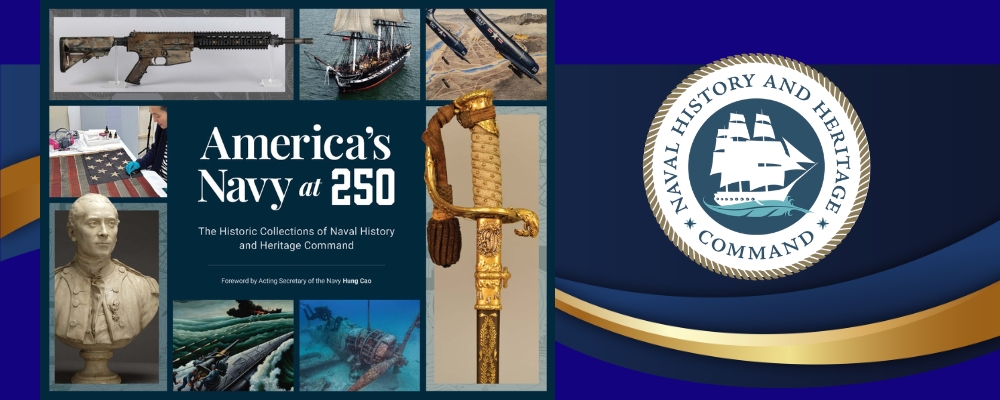
In honor of America’s 250th anniversary, the U.S. Navy and the Naval History and Heritage Command (NHHC) have published a 300-page keepsake book that presents a unique view of American naval history through the artifacts, artwork, and submerged cultural sites currently safeguarded by the NHHC. The contributions of curators, historians, underwater archaeologists, and other subject matter experts to these pages represent both a dedication to preserving this legacy and a desire to inspire both current and future American sailors and warfighters.
- To download a FREE full-color copy, click HERE.
The Honorable Hung Cao, Acting Secretary of the Navy writes:
“Within these pages, you will discover historic ships, aircraft, and weapons, as well as examples of technological advancements, and the personal effects of heroes, including Medals of Honor. You will see history brought to life through art that depicts historic events from the era before photography, and more. Some of these artifacts will elicit powerful emotional reactions, depicting stories of valor and sacrifice. Others chronicle amazing feats, such as the single-engine observation aircraft flown by a Republic of Vietnam Air Force pilot, who in a desperate act of courage, saved his wife and children with a successful landing on the carrier USS Midway (CVA 41) during the fall of Saigon.
“Some artifacts are whimsical. Souvenirs collected by sailors during exotic port calls depict the Navy’s global reach. Some are poignant. The commissioning pennant for the submarine USS Thresher (SSN 593), lost at sea during trials, and the clock from the Navy Command Center at the Pentagon, frozen at the time of the terrorist attack on 9/11, tell the story of our losses.
“Other artifacts reflect the triumph of victory. The collection includes the table on which the instrument of surrender ending World War II was signed, as well as the battle flag of USS Barb (SS 220), one of the most successful submarines in history, commanded by Medal of Honor recipient Rear Admiral Eugene Fluckey.
“The collection even includes the desks of the Secretary of the Navy and the Vice President of the United States, created under the auspices of NHHC from wood and copper salvaged from the undefeated USS Constitution. The desk of the Secretary of the Navy also includes steel and other metal from the victorious battleships of World War II.
“These artifacts are stark reminders of the indomitable spirit of the American sailor. Almost every ship that was sunk in Pearl Harbor, except for USS Arizona and USS Utah, were salvaged, repaired, and refitted for service.
Rear Admiral Samuel J. Cox, USN (Ret.) Director, Naval History and Heritage Command writes:
“From humble beginnings, like America itself, the U.S. Navy has grown and developed into the preeminent naval force on the globe. The story of the United States and U.S. Navy over 250 years are inexorably linked.
“This compendium honors and commemorates both the birthday of the United States and of the U.S. Navy from the perspective of material culture. This unique view of U.S. history is carried out through the lens of artifacts in the collection of NHHC.
“With more than 400,000 artifacts to choose from, this book is a very small representative sample of the command’s much larger effort to preserve our past and inspire our current and future sailors and warfighters. Each of these artifacts reveal how the Navy too has expanded and evolved while maintaining its essential place in ensuring national security.
“Today the Navy’s active-duty sailors and reservists stand ready to confront threats anywhere around the globe, providing the nation’s leaders with unparalleled capabilities in both peacetime and times of war. This book showcases a rich legacy that American sailors may draw upon for insight and inspiration as they upload its honorable tradition of defending the nation.
“The curatorial staff at NHHC have carefully selected these historic artifacts, some of which are the most famous and iconic in the collection, such as Commodore Oliver Hazard Perry’s original “Don’t Give Up the Ship” battle flag or the Douglass SBD Dauntless dive bomber, the only surviving participant in the decisive Battle of Midway in 1942. Other choices may be surprising, such as the Confederate submarine H.L. Hunley or submerged cultural sites such as USS Indianapolis (CA 35) and USS Juneau (CL 52).
“Each of these artifacts serve as sobering reminders that victory at sea can have a very high cost. In choosing to highlight the Nobel Prize medal for Albert A. Michelson, the first to measure the speed of light, or Rear Admiral Grace Hopper’s length of wire, demonstrating how far light travels in a nanosecond, curators celebrate innovation in the Navy. Other artifacts such as the Medal of Honor for Chief Water Tender Peter Tomich—honored for his actions on USS Utah (AG 16) during the attack on Pearl Harbor—emphasize the heroism and valor that can win the day.
Jeffrey L. Bowdoin Curator Branch Head, NHHC writes:
“In formulating the basis of the selection criteria, I quickly shied away from asking my colleagues for a list of the ‘best’ artifacts they manage. How would I define ‘best?’
“With such a long and varied history, as well as a large collection to choose from, a book of the ‘best’ artifacts and artwork was not an achievable goal.
“Contributors from throughout the command were instead asked what stories they wanted to tell and were given wide latitude in what they submitted.
“Not all collecting units are equally represented throughout these pages, which is not reflective of the quality of their work or the artifacts and artwork they manage.
“Simply put, specific collecting units manage larger portions of NHHC’s overall collection than others. While specific artifacts may appear ordinary or routine and others may possess historic significance on national and global levels, they all tell a story and have a place in the Navy’s collection.
“The effort to produce this book is the result of an unprecedented level of collaboration and cooperation within the Naval History and Heritage Command. It is the first time a book effort encompassed all facets of the command.
“Staff from every division within NHHC—Collection Management; Histories, Archives, and Library; Navy Museum; National Museum Program; Communication and Outreach; and Resource Management—all contributed to the success of this book.”