DEEP, an international ocean engineering and technology company with facilities in the UK and USA, has completed installation of Vanguard, its pilot subsea human habitat at the Tennessee Reef in the Florida Keys National Marine Sanctuary following a complex marine operation.
- The Vanguard system now sits 17 meters below the water’s surface at Tennessee Reef, enabling multi-day subsea research missions.
- The next phase will focus on commissioning, testing, and operational training, followed by crews of up to four aquanauts living and working underwater for multi-day research and training missions.
- Missions will support marine science research, coral reef restoration, long-term monitoring, climate impact studies, human performance research, and training for extreme environments.
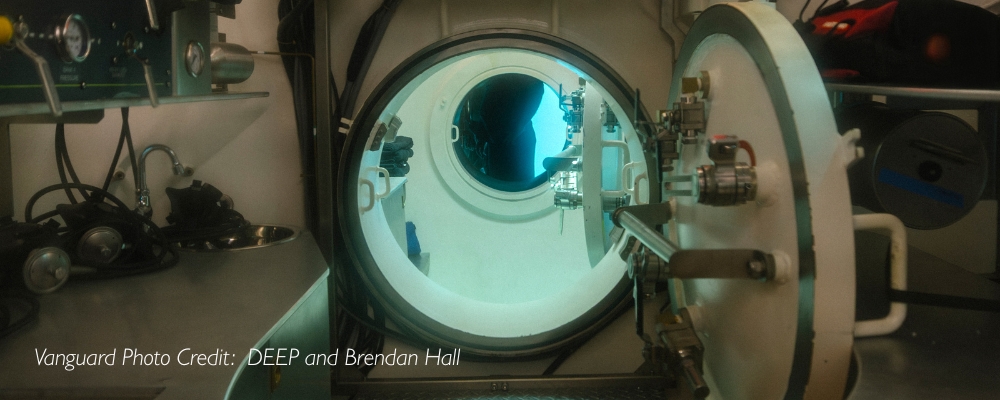
DEEP’s Vanguard is now installed on the seafloor at Tennessee Reef in the Florida Keys National Marine Sanctuary, becoming the first open-ocean subsea human habitat built, tested, and deployed in the United States in 40 years and marking a major milestone for subsea engineering, ocean research, and conservation.
Vanguard’s deployment involved setting an ocean floor foundation in place, fixing the habitat onto the foundation, and securely tethering the surface support buoy nearby.
The complete system now sits on sandy bottom at 17 meters (56 ft) ocean depth. The liveable part of the habitat measures 10.7 meters (35 ft) long x 2.5 meters (8 ft) wide and is designed to support crews of up to four aquanauts living and working underwater on research missions of five or more days.
With deployment complete, sea acceptance testing and commissioning are now underway – the final steps toward DNV classification. DNV, a global leader in maritime classification, has been engaged throughout the design and build process, providing independent technical assurance that Vanguard meets rigorous engineering standards.
DEEP will then turn its focus to habitat support crew training ahead of Vanguard’s first research missions at Tennessee Reef.
Norman Smith, Chief Technology Officer at DEEP, said:
“Installing Vanguard at Tennessee Reef was a carefully choreographed marine operation with a lot of moving parts, and the culmination of 18 months of intense design, build, and testing efforts. Today is a huge milestone and an experience I’ll never forget. Successful deployment gets us closer to enabling a continuous human presence in the ocean and is a major step forward in DEEP’s mission to make humans aquatic. From Vanguard we can expand meaningful access to the underwater environment and unlock new possibilities in marine science, environmental monitoring, human performance and extreme environment training.”
Tennessee Reef is a critical area of scientific interest. Vanguard enables scientists to live and work at depth for days at a time, dramatically increasing the volume and continuity of research that can be conducted at the reef, accelerating understanding of coral health, ecosystem dynamics, and the impacts of climate change.
Eddie Kertis, superintendent of Florida Keys National Marine Sanctuary, said: “For decades, NOAA has supported using subsea habitats as a platform to reveal ground-breaking discoveries that inform the sanctuary’s management well into the future. The deployment of a new subsea habitat within the sanctuary creates additional opportunities for marine science and builds on research infrastructure, resource stewardship, and our long-standing collaboration with the scientific community.”
Vanguard is the beginning of something larger. DEEP is building ocean infrastructure – a long-term program of habitats designed to give humans a sustained presence beneath the waves. As DEEP’s pilot habitat, Vanguard provides the real-world experience that informs what comes next: Sentinel, a larger, modular habitat system.
Initial activities supported by Vanguard are expected to include:
- Coral reef restoration operations – enabling longer-duration installation and monitoring of nursery-grown corals.
- Continuous reef condition monitoring – allowing repeated sampling of water quality, coral health, bleaching, disease, sedimentation, and benthic change over multi-day missions
- Baseline and long-term climate impact studies – supporting repeated measurements tied to warming, acidification, and storm impacts.
- Species and food web ecology surveys – enabling extended observation of marine ecosystems.
- Human physiology and performance research – generating insights applicable to clinical and extreme-environment settings.
- Development and testing of new ocean sensors and sampling tools – providing a real-world subsea platform for marine technology.
- Astronaut and extreme-environment training – supporting teams operating in isolated, high-consequence environments.
- Live education and public outreach – enabling real-time communication from the seafloor to classrooms and audiences worldwide.
Partners
DEEP’s partners on the Vanguard project include Unique Group, Bastion Technologies, Triton Submarines and Resolve Marine.
About DEEP
On its mission to make humans aquatic, ocean engineering firm, DEEP, is developing subsea habitats, systems, and training to enable a continuous human presence in the ocean. Vanguard, its pilot habitat, is the first step in a long-term infrastructure program. Next comes Sentinel – a modular habitat system designed for scale.
About DNV
DNV is a classification society and technical adviser to the maritime industry, providing testing, certification, and technical advisory services.
State of Florida funding awarded for undersea research missions
DEEP has received $935,000 in funding from the State of Florida to support research missions on Vanguard, the company’s pilot underwater human habitat at Tennessee Reef in the Florida Keys National Marine Sanctuary. The award comes just three weeks after DEEP announced Vanguard’s deployment.
The funding will support up to six research teams from Florida universities and research institutions. Each awarded team will complete a five-day mission on Vanguard between November 2026 and June 2027.
The Undersea Human Presence and Technology Advancement Program (UHPTAP) is open to research in two priority areas: reef restoration and environmental monitoring, and human-machine collaboration.
Dr. Dawn Kernagis, Director of Scientific Research at DEEP, said:
“Florida’s reefs need sustained bottom time to understand what’s happening to them. This funding gives Florida researchers access to Vanguard, so they can live and work at depth for days at a time. That’s the difference between observing a reef for an hour and actually being part of it.
This program opens Vanguard to researchers who wouldn’t otherwise have access to a saturation habitat. Six teams, two research areas, real time at depth. That’s a meaningful expansion of what’s possible for Florida science.”
The RFP is open now, with proposals due by September 1, 2026. Full eligibility requirements, priority areas, and submission instructions are available at deep.com/uhptap.
Eligible applicants must satisfy the following criteria:
- The program is open to public and private universities, colleges, and accredited research institutions in Florida.
- The lead applicant must be a Florida institution, with multi-institution teams also eligible to apply.
- Personnel participating in in-water or habitat operations must meet DEEP’s relevant dive, medical, and safety requirements.
Why the Florida Keys National Marine Sanctuary Was Selected for “Vanguard” Deployment
DEEP selected the Tennessee Reef in Florida Keys National Marine Sanctuary for Vanguard subsea habitat deployment because the site offers access to a diverse coral reef ecosystem within a controlled-access protected area.
- Deployment of a new subsea human habitat in the open ocean will be a sight not seen in the U.S. for 40 years.
- Final deployment permits were granted in March 2026 for installation within the Florida Keys National Marine Sanctuary.
- Vanguard will be operated from DEEP Station Florida, a shoreside base in Marathon supporting habitat control, aquanaut training, and emergency response.
- The habitat is designed to support up to four aquanauts living and working underwater, enabling sustained ocean research and conservation activity.
Norman Smith said: “Tennessee Reef provides Vanguard with a home in one of the world’s most important marine environments. We couldn’t be more excited to begin this next chapter. Seeing Vanguard deployed and ready to host aquanauts underwater will mark the start of a continuous human presence on the seafloor, in service of science, learning, and ocean stewardship.”
Vanguard is designed to enable up to four crew members to live and work underwater for days at a time, enabling extended time on the seafloor for ocean science, monitoring, and conservation.
Why Tennessee Reef
DEEP selected Tennessee Reef based on environmental, operational, and research criteria. The reef lies within a controlled access conservation area of the sanctuary and is suited to long-term research experiments and seafloor equipment, while ensuring the safety of aquanaut excursions and local recreational activity.
The site provides proximity to coral reef systems and access to deeper surrounding waters of scientific interest. A suitable sand patch was identified for deployment, supported by benthic surveys confirming the placement area is free from living coral and other sensitive marine resources.
Main operating base
Vanguard will be operated from DEEP Station Florida (DSF), a shoreside base located in Marathon in the Florida Keys. The main operating base needs to be in proximity to Vanguard’s deployment location to support standard aquanaut evacuation protocol. DSF will also serve as the aquanaut training facility and will house emergency hyperbaric medical equipment.
Safety and certification
Vanguard is working towards being the first subsea habitat to be classed by DNV, which has provided independent technical oversight from the outset of the project.
Jonathan Struwe, Head of UnderwaterTechnology at DNV Maritime, said: “From the earliest design tests, DEEP worked with us to ensure its systems and materials followed the highest subsea engineering standards. We look forward to strengthening this partnership as they work towards full DNV class approval of Vanguard.”
Technical facts
- Foundation installation depth: 17 meters (59 ft).
- Habitat living depth: 13 meters (46 ft).
- Configuration: Habitat mounted on a foundational baseplate with tethered surface support buoy.
- Material: Steel structure, acrylic windows.