ABS announced the release of its “Nuclear-Ready” Notation, an industry-first classification notation for marine and offshore assets designed to support future conversion to nuclear energy.
Comprehensive documentation and information on the notation is featured in the latest ABS document, the Guide for Nuclear Ready Applications for Marine and Offshore.
“The Nuclear-Ready Notation addresses a growing industry need to plan for future nuclear adoption in a structured way incorporating the technology’s specific requirements. As interest in nuclear energy as a marine and offshore power source continues to expand, and the technology develops, ABS is proud to provide industry-leading guidance for owners, designers and builders, a formal framework to incorporate future nuclear conversion into their design approach from the outset,” said Patrick Ryan, ABS Senior Vice President and Chief Technology Officer.
The notation offers a practical mechanism to help with preserving long-term flexibility, reducing the risk of major redesign later in an asset’s life cycle, and demonstrating that future nuclear conversion has been addressed in accordance with ABS requirements. This supports assets in operation using conventional power arrangements such as diesel-electric, battery-electric, or other non-nuclear systems with a way to plan ahead for nuclear adoption while continuing to operate on current power systems.
Readiness considerations evaluated under the notation may include space allocation, structural arrangements, system interfaces, safety-related features and other design elements needed to support a future nuclear conversion. The notation signals that future nuclear conversion has been built into the design approach from the outset rather than treated as a distant or aspirational concept.
ABS explains that a “Nuclear Ready” vessel is designed and built with the intention of using nuclear power in the future, but operates with an alternative power system until a suitable nuclear reactor is installed. This is a complex decision involving technical and commercial challenges so that systems and the design are ready for all requirements. Shipowners/operators who are uncertain about pursuing immediate nuclear installations can opt for vessels built with alternative power systems in the interim. Designing a vessel as “nuclear ready” involves significant planning and foresight so that its future nuclear conversion can be achieved efficiently, safely, and economically.
To accommodate this future conversion, specific provisions are to be included during construction, even though no reactor is immediately installed. The preparation requirements for achieving the Nuclear Ready notations can vary significantly between vessels, depending on their intended use and design. These details are to be reviewed and agreed upon by the shipowner, shipbuilder, ABS, and other applicable stakeholders on a case-by-case basis.
Download a copy of the ABS Guide for Nuclear Ready Applications for Marine and Offshore HERE.
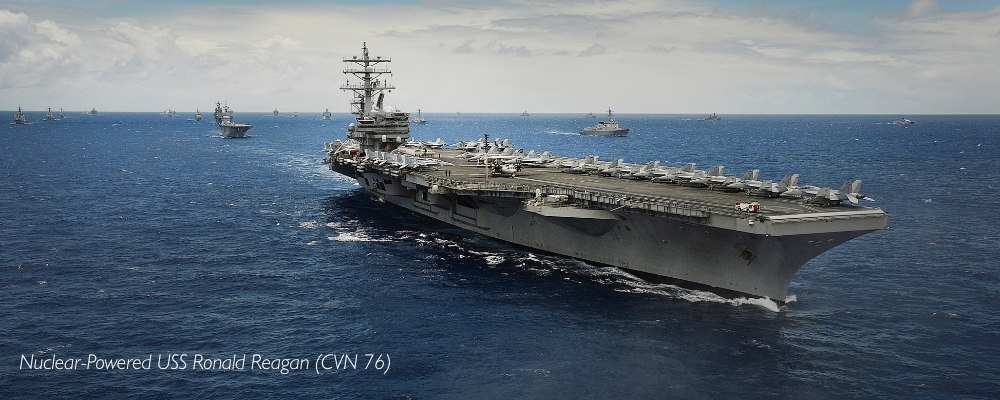
There are approximately 160 active maritime vessels powered by nuclear reactors worldwide. The vast majority are military, though a handful of specialized civilian ships also utilize the technology. To read more about the development of nuclear-powered vessels from the World Nuclear Association, click HERE.
About Maritime Ship Notations
Maritime ship notations are standardized symbols, letters, and numbers assigned by classification societies (like ABS Notations and Symbols or DNV) that detail a vessel’s structural integrity, design capabilities, and operating limitations. They are essentially documentation that proves the ship complies with strict safety and construction rules. Notations are also required for insurance purposes, inasmuch as underwriters use them to assess risk profiles and set premiums for maritime voyages.
Ship notations are typically broken down into several specific categories:
- Character of Classification, which are primary symbols indicating the condition and structural soundness of the ship’s hull and machinery
- Service Notations, which specify exactly what the vessel is designed to do, who can be on board, and what cargo it can carry
- Navigation Notations, which indicate the geographical limitations and operational boundaries for which the ship is structurally approved
Other types of class notations can refer to built-in features, equipment, or specialized capabilities of the vessel. Both crew and operators depend on notations to understand what a ship is cleared to do.
ABS Grants Approval for Nuclear Reactor Integration in Vessel Design Developed Through MIT Maritime Consortium
On June 5, 2026, ABS anounced that it had issued approval in principle (AIP) for the integration of a nuclear reactor into a cargo vessel propulsion system developed by the Massachusetts Institute of Technology (MIT), HD Korea Shipbuilding & Offshore Engineering (HD KSOE) and Capital Maritime Group.
This design uses a special synthetic fluid to carry heat from the reactor core. Today’s designs typically focus on micro-scale thermal outputs of 10 to 20 megawatts. The MIT design’s near-atmospheric operating pressure can allow for thinner, lighter reactor vessels, supporting modular construction and easier transport.
This is the first AIP to be granted through the MIT Maritime Consortium, where ABS, HD KSOE and Capital Maritime Group are founding members. ABS reviewed the reactor-to-machinery interface based on class requirements.
The consortium brings together academia and industry to advance technologies with the potential to reshape the maritime sector, including alternative fuels, new nuclear technologies, data-driven operational strategies, autonomy, cybersecurity and onboard manufacturing.
“As the industry evaluates new pathways for the future, this approval in principle highlights the value of collaboration with key stakeholders in advancing promising commercial nuclear technologies. The MIT reactor design is an interesting piece of technology. With characteristics that can support modular fabrication and vessel integration, these emerging technologies represent one possible pathway toward the safe, practical development of next-generation commercial shipping solutions,” Mr. Ryan said.
“As global environmental regulations tighten, the maritime sector requires paradigm-shifting solutions. Nuclear energy represents one of the most promising alternatives to traditional fossil fuels. Through this successful collaboration with ABS, MIT, and Capital Maritime Group, we are proud to demonstrate our readiness to lead the eco-friendly vessel market by presenting a safe and innovative nuclear-powered shipping solution,” said Sangmin Park, Senior Vice President at HD KSOE and Head of Green Energy Research Laboratory.
“It is our responsibility as an industry to explore every potential solution, including those that challenge conventional thinking. Nuclear propulsion is one such frontier. Through our membership in the MIT Maritime Consortium alongside ABS and HD KSOE, we are committed to ensuring that any pathway to net zero is grounded in the non-negotiable highest standards of crew safety, vessel integrity, and environmental protection. This AIP is the first step in that process,” said Stergios Stergiou, Chief Sustainability Officer, Capital Clean Energy Carriers Corp.
“The MIT Maritime Consortium is a unique collaboration between academia and key industry stakeholders aiming to address critical gaps in the modernization of the commercial fleet through the development of bold technological solutions, industry standards, and policies. Our reactor design is one of the first concrete outcomes of this synergy, providing a realistic pathway towards nuclear propulsion for commercial vessels,” said Themis Sapsis, Koch Professor of Marine Technology at MIT and Co-director of the Maritime Consortium.
The AIP is part of the ABS New Technology Qualification (NTQ) service that provides a structured approach to support the early adoption and implementation of innovative solutions. Find more HERE and learn more about the MIT Maritime Consortium HERE.
U.S. Center for Maritime Innovation Convenes Leaders to Address Regulatory Barriers to Maritime Nuclear Technologies
On June 26, 2026, the U.S. Center for Maritime Innovation (USCMI) convened industry, government and regulatory leaders for a workshop on Maritime Nuclear Technology Regulatory Barriers. Facilitated by its Secretariat, the American Bureau of Shipping (ABS), and in collaboration with the U.S. Coast Guard’s (USCG’s) Maritime Nuclear Policy Division and U.S. Maritime Administration (MARAD) leadership, the event focused on identifying and addressing the challenges associated with deploying advanced nuclear technology in the maritime sector.
The workshop brought together stakeholders from across the maritime, energy, and regulatory communities, including shipowners, shipbuilders, technology developers, classification societies and federal agencies. Participants explored pathways to enable the safe, secure and commercially viable adoption of nuclear-powered vessels and offshore energy platforms.
“The United States has a critical opportunity to lead in the deployment of next generation maritime systems powered by small modular reactors,” said Steve Carmel, U.S. Maritime Administrator. “Workshops like this ensure we are bringing the right stakeholders together to identify and address regulatory barriers, fostering innovation while maintaining the highest standards of safety and security.”
“The collaboration we are seeing across industry and government is essential to advancing maritime nuclear technologies from concept to reality,” said David Walker, Executive Director of the Secretariat operating the USCMI for MARAD and Vice President at ABS. “By convening stakeholders with diverse expertise, USCMI is helping to clarify regulatory pathways and accelerate progress toward viable, scalable solutions for the maritime sector.”
The workshop also featured keynote remarks and engagement from key federal partners, including Captain Robert Compher, Assistant Commandant for Prevention Policy at the USCG and Dr. Mehdi Reisi Fard Director of the Division of Advanced Reactor Engineering in the Office of Advanced Reactors at the U.S. Nuclear Regulatory Commission.
Through the workshop, a large audience of in-person and online participants shared their inputs on potential regulatory and other related barriers that oversight agencies need to address to facilitate safe deployment of this innovative technology in maritime applications. Discussions underscored the complexity of maritime nuclear deployment, including licensing pathways, safety frameworks, operational considerations and coordination across domestic and international regulatory bodies. Participants emphasized that continued collaboration between industry and government will be critical to enabling innovation while ensuring robust safety and security standards.
About USCMI
The James M. Inhofe National Defense Authorization Act for Fiscal Year 2023 (NDAA) directed the Secretary of Transportation, through a competitive cooperative agreement, to establish a United States Center for Maritime Innovation to support the study, research, development, assessment, and deployment of emerging marine technologies and practices related to the maritime transportation system (MTS). MARAD ultimately selected the American Bureau of Shipping (ABS) to establish and maintain the U.S. Center for Maritime Innovation as its secretariat. Support for the congressionally authorized Center comes from MARAD’s Office of Innovation through the Maritime Environmental and Technical Assistance (META) program. USCMI supports a wide range of maritime innovation critical to a safe, efficient, and competitive MTS.