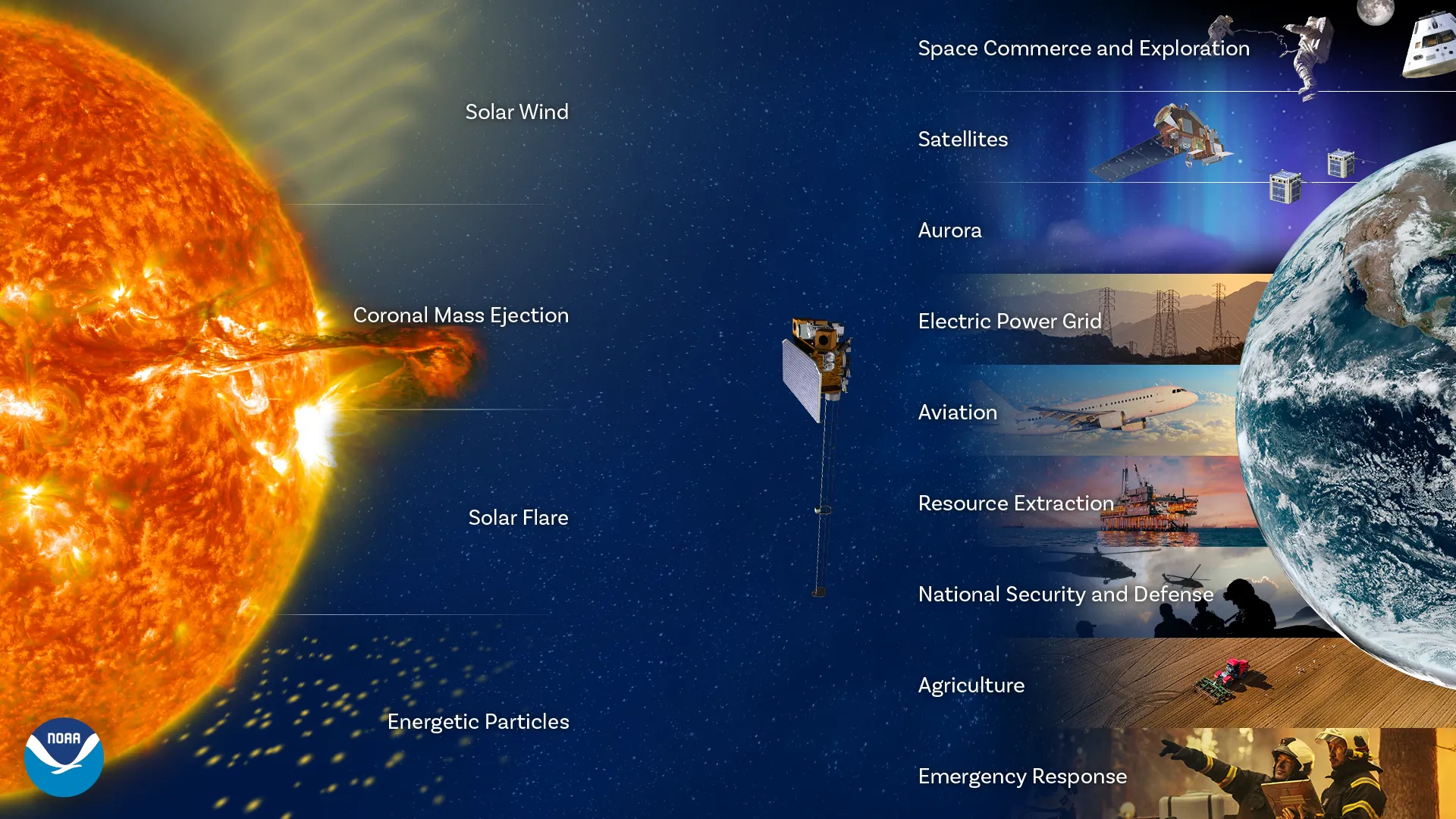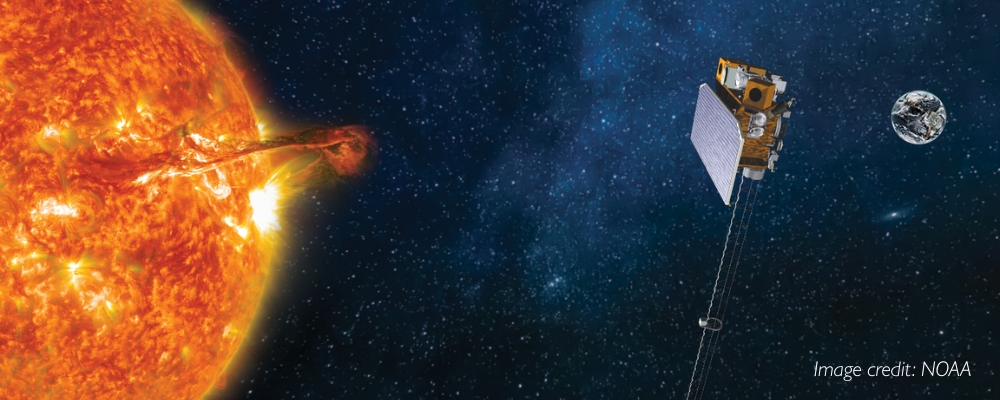
Pictured above: An artist rendering of NOAA’s SOLAR-1 satellite (formerly SWFO-L1) in its final position in space orbit next to an image of the sun producing a coronal mass ejection. Earth is seen 1 million miles away in the far distance on the right of the image. (Image credit: NOAA)
NOAA’s Space weather Observations at L1 to Advance Readiness – 1 (SOLAR-1)observatory has officially entered operational service, marking a major milestone for the nation’s resilience to space weather events. SOLAR-1 is the first U.S. satellite designed exclusively for continuous, operational space weather observations.
“SOLAR-1 will provide improved observations and high-quality 24/7 data about our sun,” said Irene Parker, acting assistant administrator for NOAA Satellite & Information Service (NESDIS). “SOLAR-1 continues the observations necessary to ensure that we are prepared for solar storms, so we can better protect the nation’s critical terrestrial and space-based infrastructure and future crewed space-flights.”
A million-mile journey to deep space
SOLAR-1, previously known as Space Weather Follow On – Lagrange 1 (SWFO-L1), successfully launched on September 24, 2025 at 7:30 a.m. EST from the Kennedy Space Center in Florida onboard a SpaceX Falcon 9 rocket. Over the next four months, the spacecraft trekked nearly one million miles to the Sun-Earth Lagrange point 1 (L1), where it is now parked to continuously monitor solar wind and observe coronal mass ejections (CME) emitted from the sun.
Before reaching initial operational capability, SOLAR-1 underwent a rigorous, eight-month, post-launch testing and commissioning period. During this time, NOAA and NASA teams meticulously checked each instrument and all primary systems, including the power, on-board computer, propulsion and attitude-control systems, communications and data storage.
Advancing readiness
SOLAR-1 strengthens the nation’s ability to safeguard systems that can be disrupted by space weather, including the electric grid, satellites, communications, aviation, navigation systems, including GPS, national security operations, and human spaceflight, such as NASA’s recently-completed Artemis II mission.
For NOAA’s Space Weather Prediction Center, SOLAR-1 is a cornerstone of the nation’s space weather early warning system, providing the observations needed to issue timely watches, warnings, alerts, and decision support before solar storms impact critical infrastructure and missions.
“It means more time to act,” said Clinton Wallace, director of NOAA’s Space Weather Prediction Center. “It gives time for power grid operators to prepare, more time for satellite operators to protect assets, more time for aviation and national security partners to understand risk, and more time for human spaceflight teams to protect astronauts and missions. SOLAR-1 helps turn observations of the sun into practical decisions that protect lives, infrastructure, the economy and national security.”
As reliance on space-based systems grows and as space exploration expands through missions such as NASA’s Artemis, sustained investment in operational space weather capabilities is increasingly vital to national readiness, astronaut safety and space asset protection.
SOLAR-1 will ensure continuity of space weather monitoring at L1, constantly streaming data down to Earth without interruption and obstruction, offering improved performance over older instruments and faster delivery of observations to NOAA’s SWPC.
For example, SOLAR-1’s coronagraph will deliver CME imagery to SWPC forecasters/users within 30 minutes of being captured in space, compared to research observatories and instruments, such as ESA-NASA’s Solar and Heliospheric Observatory’s coronagraph imaging, which can take up to eight hours. In situ data from SOLAR-1’s Solar Wind Plasma Sensor, SupraThermal Ion Sensor, and Magnetometer will be available within five minutes.
SOLAR-1, and future planned satellite missions for L1, are vital for reducing operational observations risk when it comes to collecting data and information that helps society get ahead of the threats to the nation’s critical infrastructure. SOLAR-1 data will be available to the public in real time via the SWPC website and archived through the NESDIS Space Weather Portal.
NOAA Glides into the Future with Solar Sail Technology
NOAA, in partnership with NASA and private industry, is developing a state-of-the-art solar sail that uses sunlight for propulsion to position space weather instruments closer to the sun.
- To see additional photos of the Space Sail click HERE.
Like wind propelling a sailboat through the water, solar sail technology is taking NOAA’s observational capabilities a step closer to the sun.
Through a Joint Venture partnership with NASA Marshall Space Flight Center in Huntsville, Ala., and Applied Aerospace & Defense, a private sector partner also based in Huntsville, NOAA funded $4.2 million dollars for a state-of-the-art solar sail membrane that can be attached to a satellite and allow space weather instruments to travel closer to the sun than ever before.
By allowing instruments to travel closer to the sun, solar sails can help NOAA’s Space Weather Prediction Center (SWPC) issue earlier warnings for solar storms, providing better protection to critical systems such as power grids, aviation and astronauts in space.
Sailing on Sunlight
The solar sail membrane is an ultra-thin, highly reflective, and lightweight material called polyimide, which is coated with aluminum. It is designed to harness solar radiation pressure for propellant-free spacecraft propulsion. Acting like a reflective mirror, the sail captures momentum from sunlight to generate continuous, low-thrust acceleration.
This solar sail is the largest ever manufactured. When fully deployed, the membrane will cover 17,792 square feet (1,653 square meters), which is equivalent to roughly four basketball courts placed side by side.
How Does It Work?
Solar sail technology allows a spacecraft attached to the sail to move using sunlight alone. Much like how the wind can propel a sailboat, light from the sun can essentially “push” a spacecraft equipped with a reflective solar sail.
Sunlight is composed of particles called photons. When photons strike and bounce off the sail, they transfer momentum, gradually accelerating the spacecraft. This eliminates the need for rocket propellant and enables the spacecraft to travel indefinitely.
The solar sail membrane can be packed inside a space roughly the size of a microwave oven during launch. Once in space, lightweight carbon fiber booms unroll from the spacecraft to form rigid tubes that support the ultra-thin reflective sail. When fully deployed, the sail structure forms a square measuring more than 133 by 133 feet. By adjusting the sail’s angle relative to the sun, the spacecraft can change its position.
Expanding NOAA’s Space Weather Capabilities
Solar sail propulsion could allow NOAA to position future space weather observatories closer to the sun than current missions. Observations from this vantage point would give NOAA’s Space Weather Prediction Center additional lead time to detect and forecast geomagnetic storms. Earlier warnings help NOAA protect the nation against these storms, which pose threats to satellite systems, electric power grids, and other critical infrastructure affected by space weather events.
NOAA and NASA’s Space Technology Mission Directorate (STMD) are currently exploring the possibility of using the newly manufactured solar sail in a joint demonstration mission called the Space Storm Solar Sail Sentinel (S5). The mission would showcase solar sail propulsion technology and evaluate whether the technology can support earlier detection of space weather events that can affect Earth. Discussions are ongoing, and funding for the S5 project has yet to be confirmed.
Below: NOAA Image Credit