- Click HERE to access the GLUBS sound library.
Using hydrophones to eavesdrop on a reef off the coast of Goa, India, researchers have helped advance a new low-cost way to monitor changes in the world’s murky marine environments. Reporting their results in the Journal of the Acoustical Society of America (JASA), the scientists recorded the duration and timing of mating and feeding sounds – songs, croaks, trumpets and drums – of 21 of the world’s noise-making ocean species.
“Fish have been chatting away for millions of years, and we’re just now starting to understand who is making the sounds,” said report co-author Aaron N. Rice, who is also Chief Scientific Advisor at The Fisheye Collaborative, a conservation-technology nonprofit dedicated to advancing marine conservation through innovative bioacoustic tools and techniques.
- Read an interview with Aaron Rice “Uncovering 150 Million Years of Fish Sounds” HERE.
With artificial intelligence and other pioneering techniques to discern the calls of marine life, Rice’s group recorded and identified:
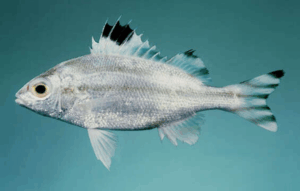
- a medium sized “grunter,” loudest at dusk, Terapon theraps
- fish of the Sciaenidae family (audio: https://bit.ly/3KWtawy);
- choruses of plankton-eating fish species (audio: https://bit.ly/3oAsGo5); and
- snapping shrimp (audio: https://bit.ly/3mTQ0gd), including commercially-valuable tiger prawns.
Some species within the underwater community “work the early shift” and create ruckus from 3 a.m. to 1.45 p.m., while others “work the late shift” and ruckus from 2 p.m. to 2.45 a.m. Plankton predators were found to be “strongly influenced by the moon.”
Also registered: the degree of difference in the abundance of marine life before and after a monsoon.
The paper concludes that hydrophones are a powerful tool and “overall classification performance (89%) is helpful in the real-time monitoring of the fish stocks in the ecosystem.”
A hydrophone is an underwater microphone used to detect and record sounds in aquatic environments. It converts underwater pressure variations into electrical signals, which are then analyzed to understand marine life, ocean currents, seafloor features, and for underwater surveillance. While some hydrophones are passive listeners, others are active, sending out sound waves to detect echoes.
The team, including Bishwajit Chakraborty, a leader of the International Quiet Ocean Experiment (IQOE), benefitted from archived recordings of marine species against which they could match what they heard, including:
- A cacophony of spawning tiger perch: (audio: https://bit.ly/3LkZYkj), and
- Snapping shrimp (audio: https://bit.ly/41NZWH2), whose sounds baby oysters reportedly like to follow
Also captured was a “buzz” call of unknown origin (https://bit.ly/3GZdRSI), one of the oceans’ countless marine life mysteries.
- Read: “The Case for a Global Sound Library” HERE.
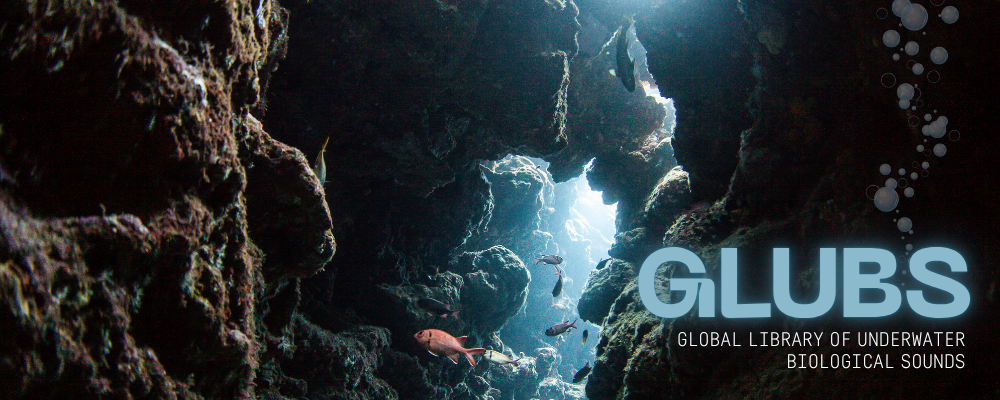
Advancing the Global Library of Underwater Biological Sounds (GLUBS)
The new Global Library of Underwater Biological Sounds (GLUBS) is a major legacy of the decade-long IQOE, which is ending in 2025.
- Read more about the IQOE HERE.
GLUBS, conceived in late 2021 and currently under development, is designed as an open-access online platform to help collate global information and to broaden and standardize scientific and community knowledge of underwater soundscapes and their contributing sources.
It will help build short snippets and snapshots (minutes, hours, days long recordings) of biological, anthropogenic, and geophysical marine sounds into full-scale, tell-tale underwater baseline soundscapes.
Especially notable among many applications of insights from GLUBS information: the ability to detect in hard-to-see underwater environments and habitats how the distribution and behavior of marine life responds to increasing pressure from climate change, fishing, resource development, plastic, anthropogenic noise and other pollutants.
- Click HERE to access the GLUBS sound library.
“Passive acoustic monitoring (PAM) is an effective technique for sampling aquatic systems that is particularly useful in deep, dark, turbid, and rapidly changing or remote locations,” says Miles Parsons of the Australian Institute of Marine Science and a leader of GLUBS.
He and colleagues outline two primary targets for the project:
- Produce and maintain a list of all aquatic species confirmed or anticipated to produce sound underwater;
- Promote the reporting of sounds from unknown sources
Odd songs of Hawaii’s mystery fish
In this latter pursuit, GLUBS will also help reveal species unknown to science as yet and contribute to their eventual identification. For example, newly added to the growing global collection of marine sounds are recent recordings from Hawaii, featuring these baffling sounds:
- Mystery fish 1 (audio: https://bit.ly/3LjHDUJ),
- Mystery fish 2 (audio: https://bit.ly/3UW24u0), and
- Mystery fish 3 (audio: https://bit.ly/3KWtVpo)
They are now part of an entire YouTube channel (https://bit.ly/3H5Ly54) dedicated to marine life sounds in Hawaii and elsewhere (e.g. this “complete and total mystery from the Florida Keys”: https://bit.ly/41w1Xbc (Annie Innes-Gold, Hawai’i Institute of Marine Biology; processed by Jill Munger, Conservation Metrics, Inc.)
Says Dr. Parsons: “Unidentified sounds can provide valuable information on the richness of the soundscape, the acoustic communities that contribute to it and behavioral interactions among acoustic groups. However, unknown, cryptic and rare sounds are rarely target signals for research and monitoring projects and are, therefore, largely unreported.”
The many uses of underwater sound
- Read “A New Approach to Decoding Fish Sounds on Coral Reefs” HERE.
Of the roughly 250,000 known marine species, scientists think all fully-aquatic marine mammals (~146, including sub-species) emit sounds, along with at least 100 invertebrates, 1,000 of the world’s ~35,000 known fish species, and likely many thousands more.
GLUBS aims to help delineate essential fish habitat and estimate biomass of a spawning aggregation of a commercially or recreationally important soniferous species.
In one scenario of its many uses, a one-year, calibrated recording can provide a proxy for the timing, location and, under certain circumstances, numbers of “calling” fishes, and how these change throughout a spawning season. It will also help evaluate the degradation and recovery of a coral reef.
GLUBS researchers envision, for example, collecting recordings from a coral reef that experienced a cyclone or other extreme weather event, followed by widespread bleaching. Throughout its restoration, GLUBS audio data would be matched with and augment a visual census of the fish assemblage at multiple timepoints.
Oil and gas, wind power and other offshore industries will also benefit from GLUBS’ timely information on the possible harms or benefits of their activities.
* * * * *
Other IQOE legacies include:
- Manta (bitbucket.org/CLO-BRP/manta-wiki/wiki/Home), a mechanism created by world experts from academia, industry, and government to help standardize ocean sound recording data, facilitating its comparability, pooling and visualization.
- OPUS, an Open Portal to Underwater Sound being tested at Alfred Wegener Institute in Bremerhaven, Germany to promote the use of acoustic data collected worldwide, providing easy access to MANTA-processed data, and
- The first comprehensive database and map of the world’s 200+ known hydrophones recording for ecological purposes
* * * * *
Marine sounds and COVID-19
The IQOE’s early ambition of humanity’s maritime noise being minimized for a day or week was unexpectedly met in spades when the COVID-19 pandemic began.
New IQOE research includes a paper, “Impact of the COVID‑19 pandemic on levels of deep‑ocean acoustic noise” (https://bit.ly/3KZTaIt) which documented a pandemic-related drop of 1 to 3 dB even in the depths of an abyss. With a 3 dB decrease, sound energy is halved.
Virus control measures led to “sudden and sometimes dramatic reductions in human activity in sectors such as transport, industry, energy, tourism, and construction,” with some of the greatest reductions from March to June 2020 – a drop of up to 13% in container ship traffic and up to 42% in passenger ships.
Other IQOE accomplishments include achieving recognition of ocean sound as an Essential Ocean Variable (EOV) within the Global Ocean Observing System, underlining its helpfulness in monitoring:
- climate change (the extent and breakup of sea ice; the frequency and intensity of wind, waves and rain)
- ocean health (biodiversity assessments: monitoring the distribution and abundance of sound-producing species)
- impacts of human activities on wildlife, and
- nuclear explosions, foreign/illegal/threatening vessels, human activities in protected areas, and underwater earthquakes that can generate tsunamis
The Partnership for Observation of the Global Ocean (POGO) funded an IQOE Working Group in 2016 that quickly identified the lack of ocean sound as a variable measured by ocean observing systems. This group developed specifications for an Ocean Sound Essential Ocean Variable (EOV) by 2018, which was approved by the Global Ocean Observing System in 2021. IQOE has since developed the Ocean Sound EOV Implementation Plan, which was reviewed in 2022 and presented at IQOE’s April 26, 2025 meeting.
* * * * *
One of IQOE’s originators, Jesse Ausubel of The Rockefeller University’s Programme for the Human Environment, says the programme has drawn attention to the absence of publicly available time series of sound on ecologically important frequencies throughout the global ocean.
“We need to listen more in the blue symphony halls. Animal sounds are behavior, and we need to record and understand the sounds, if we want to know the status of ocean life,” he says.
The program “has provided a platform for the international passive acoustics community to grow stronger and advocate for inclusion of acoustic measurements in national, regional, and global ocean observing systems,” says Prof. Peter Tyack of the University of St. Andrew’s, who, with Steven Simpson, guide the IQOE International Scientific Steering Committee.
“The ocean acoustics and bioacoustics communities had no experience in working together globally, and coverage is certainly not global; there are many gaps. IQOE has begun to help these communities work together globally, and there is still progress to be made in networking and in expanding the deployment of hydrophones,” adds Prof. Ausubel.
A description of the project’s history and evaluation to date is available at https://bit.ly/3H7FCbN.
* * * * *
Encouraging greater worldwide use of hydrophones
According to Dr. Parsons, “hydrophones are now being deployed in more locations, more often, by more people, than ever before.”
To celebrate that, and to mark World Oceans Day, June 8, GLUBS recently put out a call to hydrophone operators to share marine life recordings made from June 7 to 9, 2025. So far, they have received interest from 124 hydrophone operators in 62 organizations from 29 countries and counting. The hydrophones will be retrieved over the following months with the full dataset expected sometime in 2024.
They also plan to make World Oceans Passive Acoustic Monitoring (WOPAM) Day an annual event – a global collaborative study of aquatic soundscapes, salt, brackish or freshwater – the marine world’s answer to the U.S. Audubon Society’s 123-year-old Christmas Bird Count.
On June 8th, 2023, scientists all around the world participated in a global study of aquatic sound. Underwater sound recordings from over 250 sites all over the world were then shared to create a snapshot of the cacophony of noises generated by wildlife and humans.
Click HERE to scroll over the sites marked with stars to hear some of the interesting sounds that have already been submitted from the study!