At the November 2025 Floating Offshore Wind Conference in Aberdeen, Scotland, the ABS (American Bureau of Shipping) issued an approval in principle (AIP) to Encomara for its Squid™ system, a novel approach that adapts proven disconnectable mooring technology to support floating offshore wind developments.
The Squid™ system builds upon the established Disconnectable Turret Buoy (DTB) concept long used in floating production projects. By utilizing existing, well-understood offshore technology and installation methods, the system aims to enhance safety and reduce complexity during floating wind turbine installation and off-station operations.
“Floating offshore wind continues to evolve rapidly, and innovation in proven technologies such as disconnectable systems plays an important role in supporting safe and efficient deployment,” said Rob Langford, ABS Vice President, Global Offshore Renewables. “ABS is pleased to support Encomara in this development through our AIP process, which provides early-stage technical review and Class requirements.”
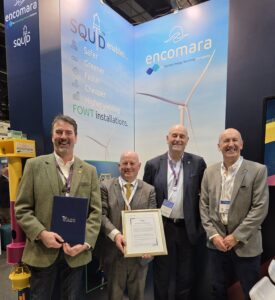
Encomara Managing Director Ian Donald said: “The potential efficiency gains, not to mention improvements in project scheduling for offshore turbine operators, could be game-changing. This is a prime example of drawing on decades of North Sea oil and gas engineering heritage and repurposing it to support energy transition through the faster roll-out of offshore wind turbines. Obtaining ABS AIP certification confirms our design meets international offshore standards and is an important step forward in realizing the huge potential of SQUID.”
With offshore expertise and innovation spanning more than 70 years, ABS provides best-in-class offshore services, assessing new and evolving solutions to help safely manage assets for offshore operations. Learn more here.
What is SQUID for Floating Offshore Wind?
SQUID is a universal, pre-installed mooring & power cable interface which is compatible with a variety of hull designs.
SQUID integrates all associated marine hardware components, such as power cables and connectors, mooring lines and anchor interfaces to provide a rapid and simplified “Plug to Power”‘(P2P) capability. It is suspended mid water and holds power cables & moorings in a similar configuration to that when connected, ensuring high operability & reduced risk of damage to hardware and the seabed. This allows developers to pre-install 100% of subsea & marine hardware in advance of FOWT deployment and maximize the pre-commissioning similar to fixed wind, prior to the turbine arrival. This significantly reduces the direct CAPEX and duration of Floating Offshore Wind Turbine (FOWT) installation. Additionally, by solving the Tow to Port (T2P) challenge, the SQUID delivers similar cost and duration reductions during the operational, re-power and decommissioning phases.
SQUID significantly reduces hazardous marine operations and deck operations by maximising safer ROV based operation under the water. During FOWT deployment the SQUID is pulled into a dedicated J-tube in a single lift which enables rapid installation of multiple FOWTs. The J-tube configuration is ‘agnostic’ to various hull interface configurations.
SQUID can be installed in a wide range of sea states, which supports a longer weather window for operations with minimal intervention downtime, reducing standby vessel support and helping to lower the carbon footprint of offshore wind projects.
SQUID is aligned with operators and developers ESG strategies and the industry’s increasing commitment to sustainability and net zero.
Aurora Energy Services Acquires Encomara – Strengthening Floating Wind Technology & Subsea Systems Capability
In June 2025, Aurora Energy Services acquired Encomara, a specialist in floating wind deployment systems and subsea engineering, and will provide significant investment to support the roll-out of its flagship mooring connection technology.
The acquisition brought into the Aurora fold Encomara’s innovative SQUID system – a proprietary quick-connect system that integrates pre-installed mooring and electrical connections in one modular subsea unit.
The system is designed to reduce the cost, time, and risk associated with the deployment, recovery and reconnection of floating offshore wind turbines.
By allowing tow-to-port strategies and decoupling installation phases, SQUID significantly de-risks offshore construction and O&M campaigns, offering major gains in safety, schedule, and repeatability. It also facilitates future multi-use infrastructure strategies, including dynamic inter-array systems and hybrid generation models.
Aurora Energy Services CEO, Doug Duguid, said: “Encomara’s SQUID system is a step-change in floating wind development and this acquisition aligns perfectly with our technical strategy. SQUID allows operators to modularise and industrialise offshore construction and combined with our fabrication and engineering capability, it gives Aurora a unique position in the market.”
“We are committed to providing key investment in the SQUID system to develop prototypes, in extensive offshore testing and roll-out to market, as we believe this is a true game-changer and it supports our ambition to lead in the energy transition.”
Encomara’s UK-based team will relocate to Aurora House in Dyce, Aberdeen, maintaining its brand and product identity while benefiting from Aurora’s global infrastructure and client network.
Its consultancy business, which offers specialist advice on floating wind, mooring systems, and subsea field development, will continue to operate as normal but now has access to greater scale, resource and reach.
The integration of Encomara’s leadership team into Aurora was also central to the acquisition. Executive Chairman Ian Donald and CEO Raymond Semple, joined Aurora’s board and executive leadership team, with Raymond assuming the role of Chief Operating Officer, based at Aurora’s Houston office, while Ecomara’s Chief Technology Officer, Malcolm Bowie, will continue in the same role in Aurora.
Current Aurora COO, Tom Smith, will take on a new role as Regional Director for EAME (Europe Africa and Middle East) to harness growing market opportunities and will continue as a member of the executive board.
Ian Donald has more than 40 years of offshore subsea field development experience and held senior roles at Venture, Apache and Neptune, He also previously founded Enpro Subsea and DES Operations Ltd, both acquired after successful global commercialisation of patented technology. Raymond Semple, formerly COO of Technip North America and Brazil, and most recently head of Baker Hughes’ Subsea Production Systems business, brings three decades of operational and project delivery expertise across deepwater basins worldwide.
Ian Donald said: “Aurora’s ambition and capability give Encomara the ideal platform to accelerate our roadmap and bring the SQUID system to more markets, more quickly. Together, we can industrialise floating wind deployment while staying focused on innovation, safety, and engineering quality.”
Ian Cobban, a co-founder of Encomara, added: “I’m very excited to see the Aurora and Encomara teams move to commercialise the SQUID system, which will become a key part of the new Floating Offshore Wind (FLOW) delivery model.”
Aurora, established in 2022 and headquartered in Inverness, Scotland, now operates across 11 international bases in the UK, United States, Australia and South America, providing fabrication, subsea engineering, technical manpower, inspection, integrity, and specialist access services to clients across renewables, conventional energy and decommissioning.
This acquisition reinforces Aurora’s strategy to support the energy transition through investment in enabling technologies that support Net Zero goals and experienced leadership, and it supports the delivery of integrated offshore solutions across its international portfolio.