The Federal Aviation Administration (FAA) announced on August 25, 2026 that it is issuing a Request for Information (RFI) entitled “Siting New Spaceports and Use of Priority Airspace for Critical Space Launch Corridors” to solicit public and industry input on two elements of the recently published 2026 National Space Transportation Policy (NSTP): siting new spaceports and the development and use of priority airspace for critical space launch corridors.
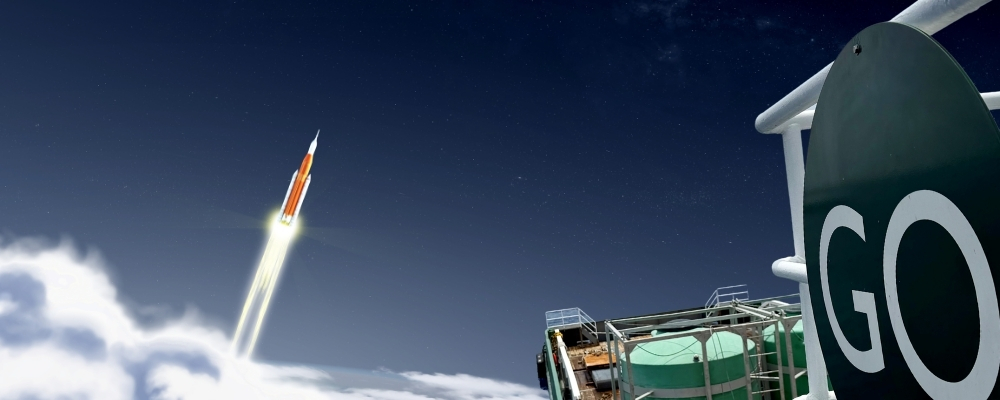
Repurposing offshore oil rigs for space launches has emerged as a proposed solution to solve a severe shortage of terrestrial launch pads caused by the exponential boom in private spaceflight.
The purpose of this RFI is to solicit information to support the FAA and U.S. Department of Transportation’s analysis in expanding opportunities for commercial space transportation and the 2026 NSTP objectives. Written comments, including all supporting information and documents, are due on or before October 26, 2026.
- For detailed instructions on how to submit comments, and a list of specific questions on which to respond, click HERE.
Existing Space Centers Need Support for Increasing U.S. Space Launch Rate
In 2025, the United States was responsible for 217 of 329 space launches worldwide. An ever-increasing launch rate is expected to reach 10,000 FAA-licensed launches and re-entries a year by 2035, driving the cadence from a few launches a week to several launches and re-entries a day. Currently, over half of U.S. launches originated from federal sites Cape Canaveral Space Force Station, Kennedy Space Center in Florida and Vandenberg Space Force Base in California, accounting for 83 percent of U.S. launches.
Soon, new and upgraded facilities, improved efficiency and policy updates are expected facilitate the security and defense of vital U.S. national and economic commercial space equities. To do that, the FAA is working to identify potential locations for additional launch facilities and targeted development or improvement of launch infrastructure. Such spaceports would ideally be viable locations to complement or augment many of the existing operations from the aforementioned spaceports, as well as the National Aeronautics and Space Administration’s (NASA) Wallops Flight Facility.
Thus, the Department of Transportation seeks input from the space and aviation industries and other interested stakeholders, specifically, on considerations for developing priority airspace for critical space launch corridors, the ideal requisites for priority airspace, and concepts for differentiating standard airspace used for commercial space activities from priority airspace.
Currently, however, the FAA explained that federal ranges are strained to support both governmental and commercial space launches. Even with enhanced efficiency at Federal launch and re-entry sites, the United States may find availability of launch and reentry sites becoming a bottleneck to achieving its space goals. The FAA noted that the United States must prepare for the rapid expansion of launch cadence by supporting increased spaceport capacity, additional launch sites, and support infrastructure to ensure continuous dominance in commercial space.
The fundamental requirements that drove site selection for the Eastern and Western Test Ranges in the 1950s remain unchanged. Geography allowing launch and re-entry over open water, available infrastructure to support launch logistics ( e.g., roads and utilities), and accessibility to space with minimal overflight of foreign countries remain, key metrics to spaceport success.
The DOT also oversees FAA-licensed commercial spaceports and private single-use launch sites. A viable spaceport involves several tradeoffs. The Office of Commercial Space Transportation developed a brief Spaceport Licensing Primer: An Introduction to the Spaceport Licensing Process to provide information for individuals not familiar with the development of commercial spaceports.
A critical aspect of spaceport development will be funding. This has led to the establishment of the National Infrastructure Development Office (NIDO) in the DOT to expand and encourage use of public-private partnerships in infrastructure development, which would include structuring spaceport development. This RFI also solicits information on funding mechanisms and the potential utility of public-private partnerships in spaceport development.
Space Launch Corridors
In addition, the 2026 NSTP directs the DOT to “designate priority airspace for critical space launch corridors.”
Currently, U.S. launch operators work with the FAA Air Traffic Organization to establish Aircraft Hazard Areas (AHAs) for space launches to protect aircraft from space objects and falling debris. Because the same spaceports support the majority of U.S. space launches, the same or similar AHAs for safety are repeatedly used.
Although the FAA does not currently use the term “space launch corridor,” the RFI questions below are intended to explore the relationship and assumptions related to the current AHAs and the new critical space launch corridor concept.
The concept of airspace corridors, in general, is not new, and airspace corridors for aviation users may vary in definition and use from space launch corridors. For example, airspace corridors for aviation activities may look and operate differently from a potential space launch corridor, as the foundations for space launch safety account for collision and debris.
In contrast, most aviation activities need only to account for collision. From a space operator’s perspective, request time and availability are important factors enabling rapid launch cadence. From an aviation perspective, advance notification of time, size, and duration of AHAs are integral to maintaining both aviation safety and airspace efficiency.
Siting New Spaceports and Use of Priority Airspace for Critical Space Launch Corridors
RFI questions include:
1. (Spaceport Location criteria) What strategic criteria should the Department use in evaluating new spaceport siting considerations?
- What geographic aspects matter most: proximity to the equator for prograde space launches, proximity to or separation from densely populated regions, or other factors?
- What logistical considerations should be evaluated, including ease of development and access, as well as impediments to be avoided?
- What unique considerations would there be with an island spaceport versus a site on the continental United States?
- What international equities should be considered with siting (e.g., early overflight of foreign territory)?
- What should the primary safety considerations be for siting of any new spaceport, given the current public safety criteria of 1 × 10⁻⁴ casualties per operation?
2. (Existing Commercial Spaceports) Why are existing commercial spaceports underutilized?
- What Federal actions could be taken to increase orbital launches from existing commercial spaceports?
- Why haven’t these underutilized spaceports developed into operational spaceports? Can the development of existing commercial spaceports be renewed?
3. (Previously Proposed Spaceports) Noting that the Department has not been involved in selecting or developing new spaceports in the past, several spaceport options have been previously considered. The Department would like input on these potential locations.
- Spaceport Shiloh, Florida. Space Florida proposed the construction and operation of the Shiloh Launch Complex on approximately 150 acres of undeveloped Federal land.
- Camden Spaceport, Georgia. Initially, a site considered by NASA for the Apollo program, planning progressed on Camden Spaceport until local stakeholders pushed back in 2022, ending site development. The County’s current site license runs through December 2026.
- Puerto Rico Spaceport. Initially conceptualized in the 2012-2016 timeframe. Spaceport Puerto Rico was considered for light and medium launch vehicles.
- Space launch rigs. Space launch from converted oil rigs or custom-developed launch platforms.
4. (New Spaceport Location) The Department would like input on potential new locations and other options not identified specifically in this RFI.
- Where might a new U.S. vertical spaceport site be developed? Considering the factors identified in the Spaceport Licensing Primer and FAA regulations on launch sites inTitle 14 of the Code of Federal Regulations part 420, what changes might the Department make to encourage, facilitate, and promote development of a new spaceport site?
- Referring to the Spaceport Licensing Primer, what can the Department do to address the four challenging areas in spaceport development: (1) stakeholder engagement, (2) co-location with an airport, (3) environmental issues, and (4) airspace integration?
- Are there locations where the necessary infrastructure already exists for establishing a spaceport? For example, transport links such as wide-load highways or deep-water ports.
- What are the primary costs associated with developing a new spaceport?
- What strategies and technologies could be utilized to expedite construction?
- What are the supply chain constraints for construction, and how could they be addressed?
- What energy constraints exist, and how could they be addressed?
- What funding constraints exist, and how could they be addressed, to include alternative financing structures? How could public-private partnerships best be leveraged to finance spaceport development?
5. (Critical Space Launch Corridors) As the Department develops critical space launch corridors, what expectations do the space and aviation industries have regarding prioritization?
- How can the implementation of space launch corridors limit adverse impacts to airspace efficiency and the continued growth of the air transportation industry?
- What benefits to either or both industries would be granted when utilizing critical space launch corridors?
- What adjustments to operational and coordination timelines might be made when utilizing critical space launch corridors?
- Assuming standard existing procedures apply for activities that do not use critical space launch corridors, what activities would qualify for activation of the critical space launch corridors?
- How would the payload characterization (commercial, civil, or national security) impact the development or use of critical space launch corridors?
- What spaceports would most benefit from critical space launch corridors: all spaceports, major use spaceports, or only Federal spaceports?
- What governance structures would enhance the use of critical launch corridors, to include fees, operational restrictions, or other oversight methodologies?
- What limitations or emergency measures would need to be established to ensure public safety during commercial space activities and continued aviation safety for the flying public?
- What environmental concerns should be considered in determining where to locate, and when to activate, critical space launch corridors?
- How would the identification of a corridor as a “critical space launch corridor,” which is not a current term in AHAs, increase awareness, streamline timing requirements, and enable greater launch cadence?