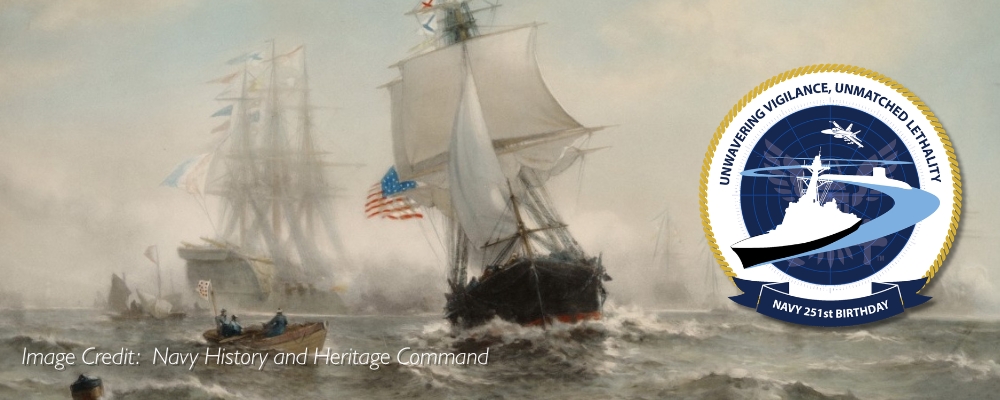
Above: Edward Moran, First Recognition of the US Flag by a Foreign Government (In the Harbor of Quiberon, France, February 13, 1778) Salute to the USS Ranger in Command of John Paul Jones, lithograph, 1898; 28 in X 38 in. (Naval History and Heritage Command, 20-001-A)
October 13, 2026 will mark the U.S. Navy’s 251st Birthday.
In 1972, Chief of Naval Operations (CNO) Admiral Elmo Russell “Bud” Zumwalt Jr. designated October 13 as the Navy’s official birthday, to “enhance a greater appreciation of our Navy heritage, and to provide a positive influence toward pride and professionalism in the naval service.”
The central theme of the 2026 celebration is “Unwavering Vigilance, Unmatched Lethality,” which highlights our Navy’s focus, emphasizing that we are steadfast, on watch, forward deployed with sailors to deliver decisive combat power.
History of the U.S. Navy Birthday From the Naval History and Heritage Command
The Chief of Naval Operations has stated that the Navy Birthday is one of the two Navy-wide dates to be celebrated annually. This page provides historical information on the birth and early years of the Navy, including bibliographies, lists of the ships, and information on the first officers of the Continental Navy, as well as texts of original documents relating to Congress and the Continental Navy, 1775-1783.
The United States Navy traces its origins to the Continental Navy, which the Continental Congress established on 13 October 1775, by authorizing the procurement, fitting out, manning, and dispatch of two armed vessels to cruise in search of munitions ships supplying the British Army in America. The legislation also established a Naval Committee to supervise the work. All together, the Continental Navy numbered some fifty ships over the course of the war, with approximately twenty warships active at its maximum strength.
After the American War for Independence, Congress sold the surviving ships of the Continental Navy and released the seamen and officers. The Constitution of the United States, ratified in 1789, empowered Congress “to provide and maintain a navy.” Acting on this authority, Congress ordered the construction and manning of six frigates in 1794, and the War Department administered naval affairs from that year until Congress established the Department of the Navy on 30 April 1798.
Not to be confused with the Navy Birthday or the founding of the Navy Department is Navy Day. The Navy League sponsored the first national observance of Navy Day in 1922 designed to give recognition to the naval service. The Navy League of New York proposed that the official observance be on 27 October in honor of President Theodore Roosevelt, who had been born on that day.
In 1972 Chief of Naval Operations (CNO) Admiral Elmo R. Zumwalt authorized recognition of 13 October as the Navy’s birthday. In contrast to Navy Day, the Navy Birthday is intended as an internal activity for members of the active forces and reserves, as well as retirees, and dependents. Since 1972 each CNO has encouraged a Navy-wide celebration of this occasion “to enhance a greater appreciation of our Navy heritage, and to provide a positive influence toward pride and professionalism in the naval service.”
Birthplace of the U.S. Navy
The Continental Congress’s resolution to procure two armed vessels, adopted in Philadelphia, Pennsylvania, on 13 October 1775, was the original legislation out of which the Continental Navy grew. Within a few days of that vote, Congress established a Naval Committee, which directed the purchasing, outfitting, manning, and operations of the first ships of the new Navy, drafted naval legislation, and prepared rules and regulations to govern the Navy’s conduct and internal administration. Philadelphia was also the port where the purchase and outfitting of the first four vessels of the Continental Navy took place.
Because the Continental Navy began in Philadelphia on 13 October 1775, the Navy claims that date as its birthday. A logical corollary would be to recognize Philadelphia as the Navy’s birthplace. The Navy, however, also honors the significant naval roles that many other towns played in the American Revolution and does not recognize any as its sole place of origin.
Several localities, in addition to Philadelphia, claim the title “birthplace of the Navy.” Machias, Maine, points to the seizing of the Royal Navy schooner Margaretta by a small sloop armed with woodsmen on 12 June 1775.
Providence, Rhode Island, asserts its title as the site of the first call for the establishment of a Navy. Beverly and Marblehead, Massachusetts, base their claim on their role in fitting out and manning the small fleet of schooners George Washington employed in the autumn and winter of 1775 to prey on enemy transports. The claim of Whitehall, New York, is based on naval and amphibious operations on Lake Champlain undertaken by the Continental Army under the command of Benedict Arnold. It should be noted that Washington’s and Arnold’s operations were manned and officered entirely under the authority of the Continental Army. There was no institutional continuity between Washington’s or of Arnold’s command and the Continental Navy, established as a separate institution by the Continental Congress. The United States Navy considers its beginnings to have been the Continental Navy, not the Continental Army.
Unquestionably the contributions of all of these as well as of other towns to the commencement of naval operations in the American Revolution deserve recognition in any naval history of our country. Perhaps it would be historically accurate to say that America’s Navy had many “birthplaces.”
The Establishment of the Department of the Navy
From 1794 until 1798, administration of the naval affairs of the United States was the responsibility of the Department of War. On 30 April 1798, Congress established the Department of the Navy. They did this in order to meet the need for an executive department responsible solely for, and staffed with persons expert in, naval affairs, on the eve of the commencement of armed hostilities with the naval forces of France, the conflict known as the Quasi-War. Benjamin Stoddert, a Maryland merchant who had served as secretary of the Continental Board of War during the American Revolution, became the first Secretary of the Navy.