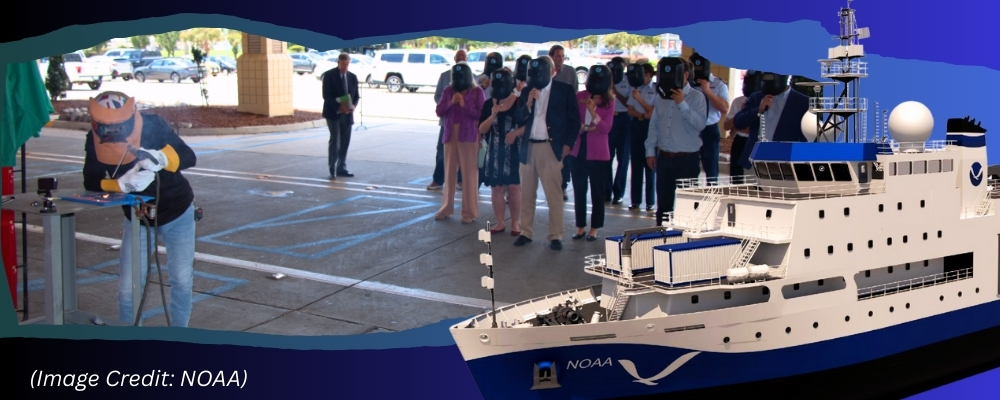
Above: A welder from Thoma-Sea Marine Constructors, LLC, welds the initials of the Surveyor’s sponsor, Tracey L. Brennan, onto a steel plate that will be incorporated into the ship, in keeping with maritime tradition, at a keel-laying event for the new ship on August 14, 2025, in Houma, Louisiana. Also, a rendering of what the new ships will look like. (Image credit: NOAA)
NOAA leadership was joined by partners earlier this year to celebrate the keel-laying for Surveyor, a new charting and mapping vessel being constructed for NOAA. The vessel is being built by Thoma-Sea Marine Constructors, LLC., in Houma, Louisiana, near Guice Offshore’s home office.
The keel-laying is a centuries-old maritime tradition that formally recognizes the start of a ship’s construction. During the ceremony, the initials of the ship’s sponsor, Tracey Brennan, the widow of NOAA Corps Rear Admiral Rick Brennan, were welded onto a steel plate that will be incorporated into the ship during construction.
In 2023, NOAA announced two new charting and mapping vessels would be added to the NOAA fleet. Surveyor is expected to be completed in 2027 and Navigator in 2028. The ships will be used primarily for ocean mapping and nautical charting as part of NOAA’s mission to deliver tools and information to help mariners safely navigate the nation’s ports and harbors.
“NOAA ships are instrumental in surveying thousands of square miles of our nation’s waters every year,” said NOAA Corps Rear Adm. Chad Cary, director of the NOAA Commissioned Officer Corps and NOAA Marine and Aviation Operations. “These new, state-of-the-art ships are another milestone in NOAA’s effort to recapitalize our aging fleet and ensure that we can continue to meet our mission to support safe navigation for years to come.”
The name Surveyor points to one of NOAA’s key missions — to conduct surveys of coasts and waterways — and it’s also the name of two former ships. Like its former namesakes, the new Surveyor will be homeported in Ketchikan, Alaska.
About NOAA’s charting and navigation work
Data collected by NOAA ships are integrated into nautical charts and other products that are essential to mariners in U.S. waters. Since 1807, originally as the U.S. Coast Survey, NOAA has kept people and commerce moving safely through U.S. waters. Today, the agency supports nearly $5.4 trillion in economic activity generated by U.S. ports each year, and ensuring safe, efficient navigation remains a central focus.
About NOAA’s Surveyor and Navigator Vessels
In 2023, NOAA announced it would be adding Surveyor and Navigator as the two new charting, research and mapping vessels to the NOAA fleet.
The names were selected from suggestions provided by NOAA staff in 2024. In accordance with NOAA policy, the names for the new vessels must fall into one of several narrowly defined categories. Both of these fall into the category of NOAA ships named for missions.
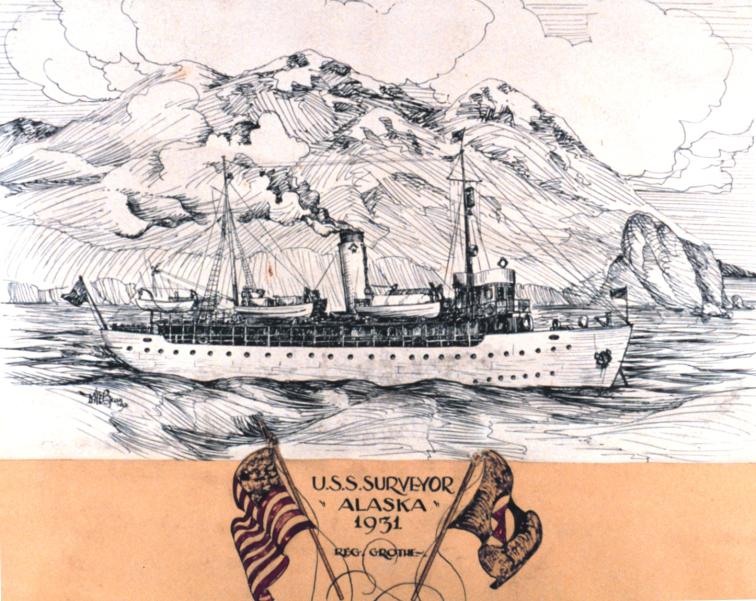
In fact, Surveyor, falls into two categories, it is also the name of two former ships. The original Surveyor was the first oil-burning steamer in the fleet of the Coast and Geodetic Survey, one of NOAA’s predecessor agencies. The ship was built in Manitowoc, Wisconsin in 1917 and spent most of its service working in the waters of the North Pacific and Bering Sea. Surveyor Bay in Alaska was named for the ship, which was used for surveys in the vicinity in 1936. The second Surveyor was in service from 1960 to 1995, during which it conducted hydrographic surveys in areas ranging from Norton Sound in Alaska to American Samoa.
New ships, long-standing mission
The Surveyor and Navigator will be built by Thoma-Sea Marine Constructors in Houma, Louisiana, and are expected to be completed in 2027 and 2028. The homeports for the ships have not been decided.
The ships will be used primarily for ocean mapping and nautical charting as part of NOAA’s mission to deliver tools and information to help mariners safely navigate the nation’s ports and harbors. Since 1807, then as the U.S. Coast Survey, NOAA has supported safe navigation and kept people and commerce moving through U.S. waters. Today, the agency enables nearly $5.4 trillion in economic activity generated by U.S. ports each year, and ensuring safe, efficient navigation remains a central focus.
NOAA ships help to survey thousands of square miles of our nation’s waters every year. The data collected is then integrated into nautical charts and other products that are essential to mariners in U.S. waters.
Future of the NOAA Fleet
The new vessels are part of an ongoing effort to revitalize NOAA’s aging fleet. As of 2023, the average age of the ships in the fleet was 30 years old. By 2030, six of those ships will likely reach the end of their service life.
In addition to Surveyor and Navigator, there are two new oceanographic vessels that are under construction, Oceanographer and Discoverer. Those ships will support a wide variety of NOAA missions, ranging from oceanographic research and exploration to studying marine life, climate and ocean ecosystems. They are anticipated to be completed in 2026.
All of the new ships being built for the NOAA fleet will incorporate the latest clean energy technologies, including vessel emission controls and high-efficiency diesel engines, as part of NOAA’s net zero emissions goal.
NOAA’s Oceanographer and Discoverer Reach Key Construction Milestones
As of April 2025, NOAA’s two new oceanographic-class research ships, Oceanographer and Discoverer, have reached a key construction milestone.
In March, Discoverer was launched in Houma, Louisiana, at Thoma-Sea Marine Constructors. The 244-foot (74-meter) ship, now 68% complete, will be homeported in Newport, Rhode Island, after its commissioning. It will support a wide variety of NOAA missions, to include exploring the deep sea, monitoring oceanographic conditions and studying marine life. Discoverer and its sister ship, Oceanographer, will incorporate the latest clean energy technologies, including vessel emission controls and high-efficiency diesel engines.

Oceanographer was floated in fall 2024, also at Thoma-Sea, and construction is 76% complete. Once commissioned into NOAA’s fleet, the ship will be homeported in Honolulu. These new ships will operate with a crew and scientists of as many as 48 people. Both ships are expected to be completed in 2026.
The U.S. Navy awarded a $178 million contract in 2020 to Thoma-Sea for the design and construction of this new class of NOAA vessels. The keel-laying for Discoverer was in October 2022.
The average age of NOAA’s 15-ship fleet is older than 30 years. By 2030, six of those ships will likely reach the end of their service life — the operational period of a ship. These new state-of-the-art ships will ensure NOAA can continue to meet its mission to support safe navigation, coastal resource management and the nation’s economy.
NOAA’s fleet of research and survey ships is operated, managed and maintained by the agency’s Office of Marine and Aviation Operations. The ships are crewed by NOAA Corps officers and civilian professional mariners.