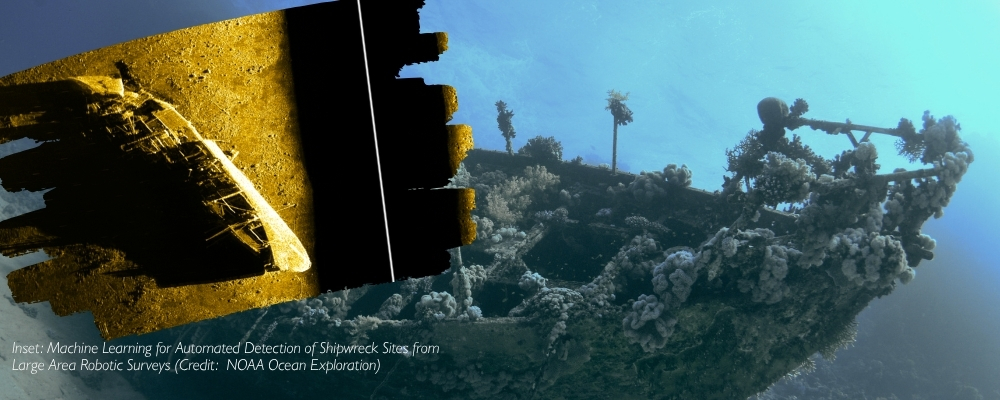
Above (inset image): Side scan sonar image of the wreck of SS Monrovia collected using Michigan Technological University’s autonomous underwater vehicle Iver 3 during the Machine Learning for Automated Detection of Shipwreck Sites from Large Area Robotic Surveys expedition. Monrovia sunk just outside of Lake Huron’s Thunder Bay in 1959. Image Credit: NOAA Ocean Exploration
Created thanks to a grant from NOAA’s Ocean Exploration program and the National Science Foundation, a new QGIS tool called ShipwreckFinder has great potential to reduce the time and cost required to detect archaeological sites from multi-beam sonar data collected across our lakes and oceans, thus accelerating the timeline for discoveries to be made by the scientific community and shared with the public. QGIS (formerly Quantum GIS) is a free, open-source Geographic Information System (GIS) plugin for desktop application that enables users to segment shipwrecks from bathymetric data, as well as create, edit, visualize, analyze and publish geospatial information.
ShipwreckFinder works by taking a multi-beam sonar scan as input and returning a segmentation mask of predicted shipwrecks, thus significantly speeding up maritime archaeology surveys. It utilizes deep learning segmentation models to identify potential sites, producing segmentation masks or bounding boxes within QGIS.
Authors of the study launching ShipwreckFinder explain ” . . . shipwrecks are an important historical marker of maritime history, and can be discovered through manual inspection of bathymetric data. However, this is a time-consuming process and often requires expert analysis. Our proposed tool allows users to automatically preprocess bathymetry data, perform deep learning inference, threshold model outputs, and produce either pixel-wise segmentation masks or bounding boxes of predicted shipwrecks. The backbone of this open-source tool is a deep learning model, which is trained on a variety of shipwreck data from the Great Lakes and the coasts of Ireland.”
The study goes on to state:
“Sunken objects such as shipwrecks and airplanes hold important archaeological, historical, and environmental data. Finding shipwrecks in large-area seafloor surveys is a time-consuming task. Typically, this is done by hand with experts who manually inspect statistical anomalies in the data and cross-reference historical shipwreck logs. In the past decade, interest in algorithmic and deep learning approaches to shipwreck detection has increased. A variety of sensors have been used for this problem, ranging from Multibeam Echosounder (MBES) and backscatter data, to orbital ocean imagery taken from satellites, to sidescan sonar, to bathymetry from LiDaR. However, these existing approaches often perform poorly on out-of-distribution data, still require expert oversight, and are rarely open-source.
“Recent advances in acoustic sensor technology and marine survey platforms have enabled efficient large area data collection to deliver massive amounts of data to marine scientists. For example, high-resolution mapping projects such as Lakebed 2030 aim to fully map the seafloor of the Great Lakes in the next half decade, greatly increasing the amount of publicly available data. However, this data has yet to be fully leveraged for training machine learning models.
By testing their model with sonar images from known shipwreck sites, NOAA explained, the ShipwreckFinder team demonstrated that a model trained with real and simulated data can return accurate results. But it wasn’t all smooth sailing, and they identified a number of recommendations for future users of their model, including:
- Incorporate a variety of data (i.e., variations in survey methodologies and sensors used, data quality, the presence/absence of shipwrecks, and the shape and structure of shipwrecks).
- Preprocess the data for machine learning input (e.g., cropping, smoothing).
- Augment the data (e.g., random scaling, translation, rotation).
- Train the model to learn how to handle gaps in data coverage.
In the Great Lakes, this toolkit was demonstrated on data from Thunder Bay National Marine Sanctuary to search for shipwrecks and other archaeological sites in its waters. But the approach is also applicable in the deep ocean.
- Link to NOAA’s Bathymetric Data Viewer HERE.
At the OCEANS 2025 Great Lakes conference, the project team presented a tutorial on their work. This tutorial, “AI4Shipwrecks: Artificial Intelligence and Machine Learning for Shipwreck Detection,” walks users through how to set up and use the ShipwreckFinder QGIS plugin for automated detection of submerged archaeological sites from multibeam sonar data.
For more information on Deepwater Outer Continental Shipwrecks, click HERE for the Bureau of Ocean Energy Management Archaeology Page.
Ships of Exploration | 19th Century Steamships | Civil War Shipwrecks
World War II Shipwrecks | Deepwater Shipwrecks
Read about how NOAA is preserving America’s historical maritime heritage through shipwreck stewardship HERE.
Watch a NOAA Library seminar on ShipwreckFinder here:
Geotechnical and Survey Clients Choose the Guice Offshore Fleet
Utilizing vessels like Guice Offshore’s 150 ft DP1 GO Liberty or the 170 ft DP1 GO Discovery, geotechnical and Outer Continental Shelf survey companies can perform detailed survey activities for their clients, such as seabed mapping, soil investigations and core sampling. Depending on their equipment installed, our vessels can work in a variety of coastal or offshore environments and water depths. With open cargo decks, ample accommodations, excellent maneuverability and station-keeping, all coupled with an efficient cost of operations, the “GO” fleet is a consistently reliable choice for this industry.