On September 28, 2026, the U.S. Navy announced its plans to procure 30 Medium Unmanned Surface Vessels following the completion of Phase I at-sea testing marking a key milestone for the program and demonstrating the Department of War’s (DOW) commitment to deliver asymmetric capability to Fleet warfighters to counter evolving threats.
Production Other Transaction Authority (OTA) agreements were awarded to Louisiana-based Galliano Marine Services, HII, and Saronic Technologies following successful at sea testing. The first MUSVs are scheduled to be delivered to the Navy prior to the end of Fiscal Year 2027.
U.S. Naval Institute News (USNI) reported that Breaux Brothers, which is partnered with HII and based in Loureauville, in Iberia Parish, is also working with Halimar Shipyard in Morgan City to build its Romulus MUSVs.
In addition to the OTA agreements, Leidos, PAC MAR Technologies, and Sea Machines were determined to complete the project provided for in their prototype other transaction agreement and will receive an award as part of the previously established terms of the prototype OTs, and alongside the OT awardees, will be accepted onto the Drones.mil hosted Maritime Marketplace, where they are now eligible to receive follow-on production agreements from authorized acquisition authorities across the DOW.
Testing evaluated, among other things, core capabilities including the vessel’s ability to see and understand the surrounding maritime environment, how well the vessels navigate autonomously according to International Regulations for Preventing Collisions at Sea, and the vessel’s ability to conduct a long-duration mission.
Building on these results, the Navy released a MUSV Phase II Integration and Testing Call for Solutions (CFS) on September 23. The CFS seeks to expand its acquisition pipeline through a Maritime Marketplace to broaden offerings and satisfy future MUSV mission sets.
“MUSVs are an important part of the hedge strategy laid out in our U.S. Navy Fighting Instructions. They give commanders a Tailored Offset — additional capacity and capability that can be rapidly adapted to the threat, distributed across the battlespace, and placed at risk without placing Sailors at unnecessary risk,” said the Chief of Naval Operations. “Just as importantly, MUSVs give us a platform for rapidly integrating new sensors, weapons, and other mission payloads as technology and operational requirements change. This is about moving beyond experimentation and putting reliable, combat-relevant capability into the hands of our Sailors at the speed the Fleet requires.”
The Direct Reporting Program Manager for Robotic and Autonomous Systems (DRPM RAS) will play a central role in accelerating the fielding and integration of MUSVs across the Fleet, ensuring these systems move rapidly from development into operational use. Working closely with the Robotic and Autonomous Systems Warfighting Development Center (RASWDC), DRPM RAS will help put reliable systems in the hands of Sailors while RASWDC develops the tactics, training, and operational experience required to employ them effectively. Through the Navy’s Containerized Capability Campaign, that partnership will give commanders adaptable platforms for rapidly integrating sensors, weapons, autonomous systems, and other mission payloads — allowing the Fleet to tailor capability to the mission and expand combat power at the speed the operational environment demands.
For more information on DRPM RAS unmanned programs and acquisition efforts, visit drpmras.navy.mil.
Saronic Awarded Production Contract for Marauder Under U.S. Navy’s MUSV Marketplace
In a press release, Saronic Technologies described the Marauder, its dual-use 180-foot autonomous ship that it will be producing under the Navy MUSV.
Saronic explained the MUSV Marketplace is a Navy acquisition initiative designed to rapidly field unmanned surface vessels by drawing on mature, commercial-ready technology rather than a traditional multi-year program of record. In June 2026, the Navy initially downselected Saronic as one of seven companies to advance Marauder to an at-sea testing phase, positioning the company to compete for a production award under the program.
Under the initiative, Saronic successfully completed a rigorous evaluation of Marauder’s performance. Over eight days of continuous, 24/7 operations, Marauder completed more than 140 test scenarios without failure. The trials were designed to test the limits of the vessel’s autonomous capabilities and included autonomously tracking and maneuvering around a variety of vessels, as well as a battery of passive-perception tests.
In these passive-perception scenarios, Marauder was required to detect, track, and follow other vessels using only its passive onboard sensors, without reliance on active radar. This capability is regarded as one of the more difficult technical challenges in autonomous maritime systems. Every scenario in the evaluation was conducted with the same platform that the Navy has now put under contract with the trials completed back-to-back in continuous operations to demonstrate the vessel’s real-world capabilities.
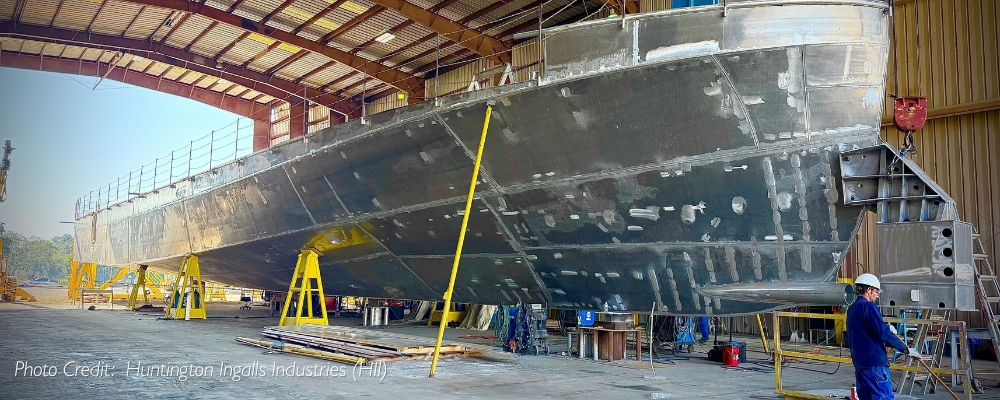
“Marauder went from initial design to on-the-water in under a year, and this evaluation demonstrated that the platform holds up under the Navy’s own toughest testing,” said Dino Mavrookas, CEO and Co-Founder of Saronic. “We’ve now flipped our third Marauder hull, with several more moving through the production line behind it. We can build at that pace because we designed the autonomy, software, hardware, and the production process side-by-side, as one system, rather than bolting them together after the fact. That’s what it means to be a vertically integrated shipbuilder, and it’s why we’ve been able to build and deliver at speed and scale.”
This award builds on Saronic’s existing production contract with the U.S. Navy for Corsair, its 24-foot autonomous surface vessel. It also follows the Navy’s recently announced contract awarding Saronic the construction of Landing Craft Utility (LCU) vessels at Port Alpha, the company’s next-generation shipyard in Brownsville, Texas. These contracts reflect Saronic’s expanding role in supplying the Navy with both autonomous and manned vessels at production scale.
HII Wins U.S. Navy Contract for 10 ROMULUS USVs, Accelerating Deployment of Proven Autonomous Capability
HII, America’s largest military shipbuilder and the global leader in autonomous seapower, also announced the contract by the U.S. Navy to build 10 ROMULUS unmanned surface vessels (USVs) for the Medium Unmanned Surface Vessel (MUSV) program. The award marks a major advancement in the U.S. Navy’s transition from experimentation to fleet-scale deployment of trusted, operational autonomy across the maritime domain.
“HII has made deliberate, early investments in the development of autonomous systems, advancing capabilities essential to the Navy’s hedge strategy,” said Chris Kastner, HII president and CEO. “We remain firmly committed to supporting the U.S. Navy’s vision and accelerating this critical capability from production to operational deployment.”
The U.S. Navy’s selection underscores HII’s shipbuilding expertise and leadership in proven autonomous unmanned surface and underwater maritime systems to deliver reliable production at the speed and scale required for emerging unmanned fleet production and operations.
At the core of ROMULUS is HII’s Odyssey Autonomous Control Solutions (ACS), a combat-tested autonomy suite that enables trusted, coordinated operations across surface and undersea domains. HII has delivered more than 750 REMUS unmanned underwater vehicles (UUVs) to customers in more than 30 countries. Together, ROMULUS, REMUS and Odyssey ACS provide a scalable foundation for autonomous maritime operations supporting the U.S. Navy and allied fleets.
In 2025, HII committed to securing the partners, production capacity, supplier network and infrastructure needed to move quickly from design and development to construction of ROMULUS USVs. That investment reflected HII’s continued support of the U.S. Navy’s unmanned maritime priorities and advancing the unmanned surface program with mature technology and a production-ready approach. By beginning work in 2025, HII positioned the ROMULUS program for accelerated delivery, reduced production risk and to provide the U.S. Navy with a scalable path to fielding autonomous unmanned surface capabilities at the pace the nation demands.
“Unmanned vessels ultimately must be built, integrated, tested and sustained as part of a fleet,” said Andy Green, president of HII’s Mission Technologies division. “As the nation’s largest shipbuilder, HII understands that challenge from both sides. By pairing our advanced cutting-edge technologies with our shipbuilding expertise, and leveraging experienced regional partners and suppliers, we are creating a production ecosystem capable of delivering reliable autonomous platforms at the pace and scale the U.S. Navy requires.”
Odyssey ACS: The Autonomy Behind ROMULUS
A key differentiator of ROMULUS is HII’s Odyssey ACS, a modular, open-architecture autonomy suite developed from decades of experience designing, building, operating and sustaining unmanned maritime systems.
Odyssey is designed to deliver consistent, predictable autonomous behavior, a requirement for the U.S. Navy’s transition from experimentation to operational deployment. It provides decision-making architecture that enables unmanned systems to perceive their surroundings, navigate, manage onboard systems and payloads, coordinate with other manned and unmanned platforms, and execute complex missions with limited human intervention.
Odyssey’s modular, open-architecture lets the U.S. Navy and allied partners rapidly integrate emerging sensors, command-and-control (C2) technologies and AI algorithms, ensuring ROMULUS remains upgrade-ready for evolving threat environments.
HII, with its partners Applied Intuition, Greenroom Robotics and Rodi Marine, successfully completed the evaluation phase of the MUSV program. HII’s Odyssey ACS vessel capabilities were validated through a series of operationally representative test events, demonstrating performance, reliability and mission readiness. The U.S. Navy-monitored testing took place in the Gulf of America over a 13-day period and evaluated the system under demanding, real-world operating conditions.
The most rigorous event was a long-endurance mission simulation. HII’s autonomy system successfully completed the full 420-nautical-mile mission over 28 hours, meeting all established success criteria and demonstrating the endurance and autonomous performance required for sustained maritime operations.
Designed and Built by Shipbuilders for Scale
For ROMULUS, HII is combining that expertise with a distributed production model that leverages regional shipbuilders and manufacturing partners. This approach expands available production capacity, strengthens the U.S. maritime industrial base and enables vessels to be produced efficiently and repeatedly as U.S. Navy demand grows.
HII is working with Gulf Coast build partners including Breaux Brothers Enterprises, Halimar Shipyard and Bayou Metal Supply & Manufacturing in Louisiana to support ROMULUS production, and developed in partnership with Beier Integrated Systems and Incat Crowther.
HII also recently announced a new10,000-square-foot expansion to increase the capacity of HII’s existing 40,000-square-foot unmanned manufacturing production campus capacity to build, develop and integrate advanced unmanned and autonomous maritime systems for both the REMUS family of UUVs and ROMULUS USVs.
The model allows major components and assemblies to be produced efficiently before final vessel integration, increasing throughput and creating a repeatable production architecture that can scale across the ROMULUS USV family.