Government representatives, maritime authorities, international organizations, and industry leaders from across the world gathered in Monaco during April 2026 for the Assembly of the International Hydrographic Organization (IHO), the principal global forum for decisions on hydrography, seabed mapping, and maritime data standards.
Held every three years, Assembly is the Organization’s principal decision-making body. Delegates from the IHO’s 104 Member States, together with observers from international organizations, met to review global progress in hydrography and set priorities for the next triennium. The 2026 Assembly was particularly significant as it included the election of the next Secretary-General and Director who will lead the Organization in the years ahead.
The April 2026 Assembly opened in the presence of HSH Prince Albert II of Monaco, who presented the prestigious Prince Albert I Medal for Hydrography, which is awarded to individuals who have made outstanding contributions to the field.
The official sessions were chaired by Michel Amafo of Suriname and also marked the formal welcome of new Member States to the global hydrographic community, including Cabo Verde, Kiribati, The Gambia, Lithuania, The Bahamas, and Panama, all of whose flags were presented during the opening ceremony.
To view an album of event photos, click HERE.
Showcasing innovation in hydrography and ocean exploration
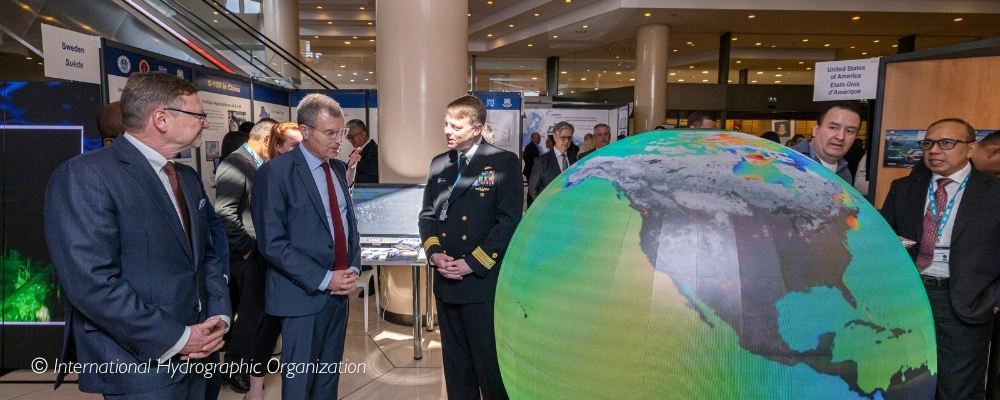
Alongside the official proceedings, a Member State and Industry Exhibition highlighted technological advances and international initiatives in hydrography, ocean mapping, and maritime services. To see a list of what exhibitors attended, click HERE.
Among the featured technologies, Exail presented its DriX O-16, a new transoceanic uncrewed surface vehicle with full ocean depth mapping capability that can operate autonomously for up to 30 days with a range of 3,500 nautical miles.
The Nippon Foundation-GEBCO Seabed 2030 Project also displayed the Bathysphere, an interactive globe allowing visitors to visualize global seabed mapping data and explore progress toward the ambitious goal of mapping the entire ocean floor.
Several countries announced the presence of research and naval vessels in Monaco during the Assembly week. The United States is expected to send the 110-metre oceanographic survey ship USNS Marie Tharp, while Italy sent its 152-metre destroyer Caio Duilio.
Focus on the future of navigation and ocean mapping
The Assembly also hosted a special thematic session dedicated to two key topics shaping the future of maritime operations and ocean knowledge:
The Smart Navigation session explored how digital technologies, maritime services, and international cooperation are transforming navigation. Speakers included:
- Nathalie Balcaen, CEO of the Flemish Maritime and Coastal Services
- Bernice Mahabier of the Maritime Authority Suriname
- Erik Eklund, Director General, Swedish Maritime Administration presenting the Baltic Sea e-Navigation project
- Antonio Di Lieto, Carnival Corporation & plc Group Center for Simulator Maritime Training
The Ocean Mapping session highlighted the global effort to better understand the seabed. Speakers included:
- Victor Vescovo, CEO of Caladan Oceanic
- Joanna Post, Head of Ocean Observations and Services at UNESCO
Reflecting the importance of international partnerships, the IHO also signed cooperation agreements with the International Association of Marine Aids to Navigation and Lighthouse Authorities (IALA) and ProtectedSeas during the Assembly.
For the first time, both the Opening Ceremony and the Thematic Session were broadcast live on the IHO YouTube channel, enabling audiences worldwide to follow the discussions. Watch the replay HERE.
About the International Hydrographic Organization
The International Hydrographic Organization is an intergovernmental organization that works to ensure all the world’s seas, oceans and navigable waters are surveyed and charted. Established in 1921, it coordinates the activities of national hydrographic offices and promotes uniformity in nautical charts and documents. It issues survey best practices, provides guidelines to maximize the use of hydrographic survey data and develops hydrographic capabilities in Member States.
Hydrography is the basis for all activities involving the sea:
| – Safety of navigation | – Tourism |
| – Protection and management of the marine environment | – Search and rescue |
| – Use of marine resources: minerals, oil & gas, renewable energy | – Maritime boundaries and policing |
| – Maritime trade | – Marine science |
| – Coastal zone management | – Marine spatial data infrastructure |
| – Fishing, aquaculture and mariculture | – Recreational boating |
| – Maritime defence and security | – Tsunami flood and inundation modelling |
The marine environment is constantly changing, whether due to climate change, extreme events, or simply the movement of tides and currents. Hydrography helps States monitor such changes and adapt their activities. For most ships for example, 30cm extra depth shown on a chart allows at least 2000 tons more cargo to be carried. The economic benefits of having an up-to-date knowledge of the marine environment can be considerable.
And yet, we know the surface of the Moon and Mars better that we know the seabed.
States are represented within the IHO by the national authority responsible for the provision of hydrographic and nautical charting services in each Member State. A Secretary General and two Directors are elected by Member States and administer the work of the Organization.