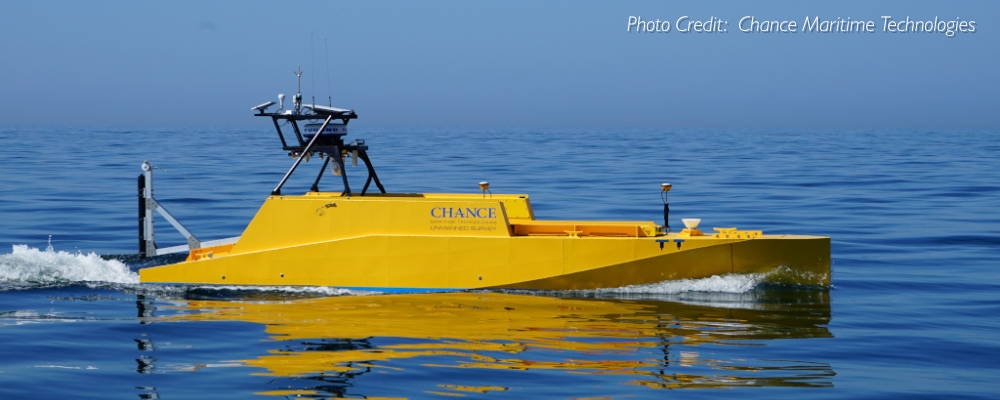
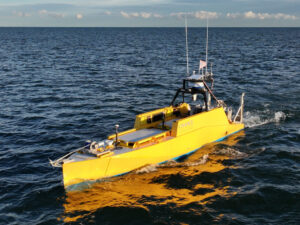
Above: The Chance LR30 returning from backscatter studies conducted with USF COMIT, where the vessel was outfitted with both a fisheries sonar and a bathymetric mapping sonar. (Photo Credit: Chance Maritime Technologies)
NOAA has purchased uncrewed marine systems to be used on new charting and mapping vessels being built for the agency that also will support NOAA’s mission to deliver tools and information to help mariners safely transport the $2.3 trillion worth of cargo that comes in and out of the nation’s ports and harbors. The uncrewed marine systems contract was awarded to Chance Maritime Technologies, LLC., from Lafayette, Louisiana (just seven miles from Guice Offshore headquarters) for up to eight total systems over five years.
The new systems offer a spectrum of command and control options. These include direct operator control, supervised control with semi-autonomous capabilities like collision avoidance and dynamic course tracking, and, for certain circumstances, fully autonomous operations. The collaborative design of the vessels and uncrewed marine systems ensure that NOAA is compliant with regulations and help to ensure safe operations.
“Uncrewed systems provide more efficiency in data collection, ensuring that our nation remains at the forefront of scientific innovation,” said Neil Jacobs, Ph.D., NOAA administrator. “The Administration’s focus on integrating emerging technologies into agency operations allows NOAA to serve the public more effectively and demonstrate our leadership in scientific collaboration on the world stage.”
In 2025, NOAA hosted keel-laying events for two new charting and mapping vessels to expand the NOAA fleet. The uncrewed systems will be used on those vessels, Surveyor and Navigator, to complement traditional seafloor mapping methods. The systems will also be equipped to support other data collection efforts such as fisheries acoustic surveys.
“NOAA is uniquely positioned to leverage cutting edge maritime technology to efficiently collect data in some of the ocean’s most challenging regions,” said Rear Adm. Chad M. Cary, NOAA Corps director and NOAA Marine and Aviation Operations assistant administrator. “Teaming these systems with Surveyor and Navigator achieves a major waypoint on the charted course to building the hybrid fleet of the future.”
NOAA Marine and Aviation Operations manages and operates NOAA’s fleet of 15 research and survey ships and 10 specialized environmental data-collecting aircraft. Operated and maintained by civilians and NOAA Commissioned Officer Corps officers, this fleet is one of the nation’s largest dedicated to federal research.
The vessels — that range from large oceanographic research vessels to smaller charting ships — support a wide range of marine activities, including fisheries surveys, nautical charting, and ocean and marine studies.
Uncrewed Maritime Systems Built for Long Endurance, High-Power Missions
The Chance LR30 is the culmination of decades of experience designing, building, and operating diesel-powered USVs at sea. At 30 feet in length, the platform features a climate controlled 12-foot payload bay, and integrated standard 19-inch rack with AC and DC power options. On deck it has modular deck rails and a sloped deck with winches for profiling sensors, as well as support for future payloads that can be towed or freely deployed off the stern.
“We are very excited to work with NOAA to advance the capabilities of uncrewed systems,” said Stuart Chance, CEO and Founder of Chance Maritime Technologies. “NOAA has been a great advocate of USV technology and operations for well over a decade, and we look forward to incorporating the Chance USVs into the NOAA fleet.”
The modularity of the vessel gives operators the freedom to reconfigure the Chance LR30 for new missions without redesigning the hull; this flexibility supports missions well beyond charting and mapping. The same LR30 that runs a multibeam survey line can be reconfigured to support fisheries assessments, marine protected area monitoring, environmental sensing, and emergency responses, making the platform a long-term investment in NOAA’s evolving science and stewardship priorities.
Few aspects of uncrewed maritime operations matter more than getting the vessel safely in and out of the water. The LR30 is engineered to make this as straightforward and safe as possible. The vessel is road-trailerable and trailer-launchable, meaning operations can stage from any standard boat ramp. For shipboard operations, the LR30’s dual-pick-point-stab system enables davit launch and recovery from a mothership.
The result is more productive survey days, fewer weather-window constraints, and reduced risk to NOAA personnel during deployment and recovery.
The Chance LR30 is powered by a direct drive diesel engine and features a streamlined, wave-piercing hull design. Its active gyrostabilizer provides superior seakeeping in heavy seas, while redundant Starlink terminals and high-bandwidth local radios support both over-the-horizon and line-of-sight operations. The Chance LR30 was designed to be operated with or without a mothership. A mast-mounted suite of sensors provides comprehensive situational awareness throughout every mission. The Chance LR30 and its software — the Chance Maritime GAR autonomy stack — are 100% designed and built in the USA.
“Uncrewed systems are transforming how we understand the ocean,” added Michael Scherer, Chief Technology Officer at Chance Maritime. “The Chance LR30 will seamlessly adapt to NOAA’s evolving mission. Whatever the agency needs to do next — new sensors, new survey areas, new discoveries — this platform is ready for it.”
About Chance Maritime Technologies
Chance Maritime designs, builds, charters, leases, and sells USVs for commercial, government and academic clients globally. Additionally, it provides payload integration and experienced USV pilots to safely and efficiently execute complex client missions. The company’s team brings more than 150 years of combined experience in uncrewed vessel design and operations, delivering dependable, mission-focused solutions.
For more information, visit www.ChanceMaritime.com