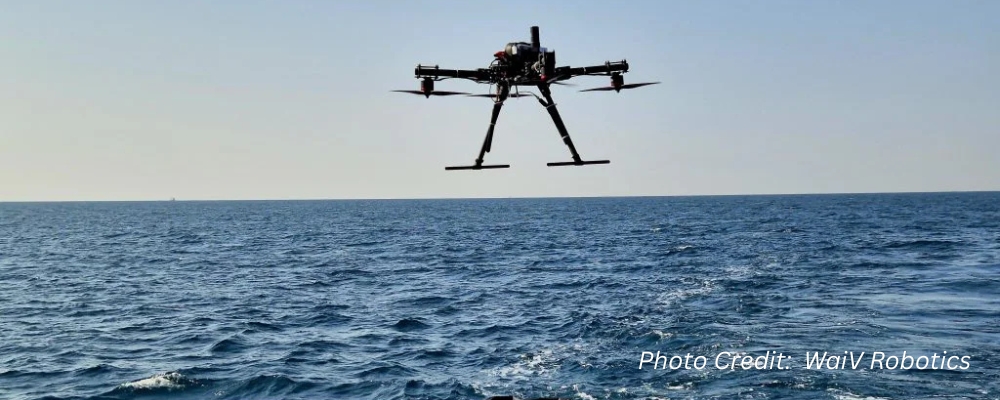
Landing a drone on a moving ship is one of the hardest problems in unmanned aviation. WaiV Robotics built a system that does it autonomously, without touching the drone itself.
Drones have become a standard tool across the energy sector, handling pipeline inspections, flare stack monitoring and offshore platform surveys with growing efficiency.
Yet one obstacle has kept maritime operators from fully integrating UAVs into their workflows: getting the drone back on the boat in one piece.
At the 10th Annual Energy Drone & Robotics Summit in June 2026, WaiV Robotics founder Johnny Carni explained how his company built a solution to a problem that had no answer in the market.
A Physics Problem
A drone in flight operates on GPS and gravity, two predictable forces that make autonomous flight relatively straightforward. A vessel at sea operates on none of those terms. The deck pitches, rolls and yaws continuously. And the motion is stochastic, meaning no algorithm can predict it perfectly in advance. Bringing a GPS-stabilized aircraft down onto a surface that moves in six degrees of freedom simultaneously presents a serious systems engineering problem. For years the industry simply worked around it by limiting offshore drone flights to calm weather windows.
Carni related how he saw this gap firsthand during his career as an electrical engineer working on EO/IR equipment and UAV program management, and later during four years based in Singapore where offshore clients explicitly asked him for a landing solution that did not yet exist. Five years ago, he and his team started building one
What the WR15 Actually Does
WaiV’s system, called the WR15, is a deck-mounted autonomous landing platform rated for drones up to 15 kilograms. The name itself reflects the spec: WAIV Robotics 15, for the maximum drone weight in kilograms the system currently supports. Three core engineering decisions define how it works.
First, the landing pad maintains a level, horizontal surface regardless of vessel motion. Gyro-stabilization on its own is not novel, and Carni was direct about that. What differentiates the WR15 is what happens at the moment of contact and immediately after (see point #3 below).
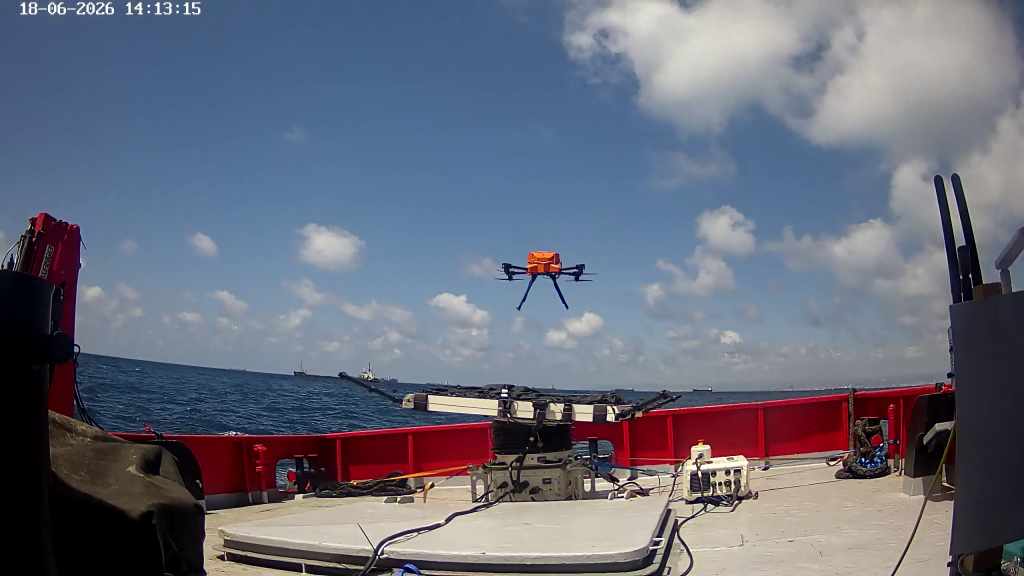
Second, the pad uses a specialized impact-absorption cushion designed specifically for maritime recovery. On land, a drone approaches slowly and settles gently. At sea, the drone must come in fast and hard, because any hesitation over a moving deck creates more risk, not less. The WR15 cushion absorbs that hard landing energy so the aircraft does not bounce back into the air.
Third, once the drone touches down, the system engages a vacuum-based locking mechanism that clamps onto the skids and holds the aircraft against any forces generated by the vessel’s continued motion. The lock engages at the moment of touchdown and releases only when commanded.
Autonomous Guidance Without Modifying the Drone
Perhaps most operationally significant, the WR15 guides the drone to touchdown. Radar, LiDAR or camera sensors on the landing pad continuously track the approaching aircraft, giving the onboard computer a precise, real-time position of the drone relative to the deck. The system then connects to the drone’s existing remote control interface and takes over flight inputs, steering the aircraft toward the pad as if a skilled pilot were on the sticks.
Crucially, this requires zero hardware or software modifications to the drone itself. WaiV simply adapts the communication protocol to each UAV type as needed. The system supports any VTOL platform, including multirotors, fixed-wing VTOLs and helicopter-style aircraft. A human pilot retains override authority by touching the control sticks, but the default recovery process runs end-to-end without human input.
The timing logic draws on an analogy Carni used to explain it. The system waits for the right moment to commit to touchdown the way a surfer reads a wave before dropping in. It hovers one meter above the deck, reads the vessel’s motion, identifies the optimal window and executes the landing. There is no go-around. When the signal comes, it commits.
Energy Sector Offshore Operations
At the EDR Summit, Carni identified offshore inspection as the primary commercial target for the WR15. Energy operators running inspection programs on vessels, platforms and port infrastructure currently face a hard ceiling on where and when drone operations are feasible. The WR15 pushes that ceiling significantly by making drone recovery reliable in sea states that would otherwise ground the program.
The system can be installed on vessels as small as 10 meters. This brings mobile drone operations within reach of smaller support vessels and crew transfer boats, not just large platform supply ships. Installation takes approximately seven minutes once components are aboard. The system can be strapped or bolted to the deck, depending on operator preference. When not in use, it can be stowed to keep the working deck clear.
Seaport operators represent another market WaiV is actively pursuing. Port environments combine vessel traffic, variable weather and a need for persistent situational awareness across large areas. All of this aligns with what autonomous maritime drone recovery enables. Defense and other applications are also within the realm of possibility.
By Dawn Zoldi, Reprinted from Autonomy Global
WaiV Robotics launches its autonomous drone landing platform in the U.S.
In June 2026, WaiV Robotics, a maritime autonomous infrastructure developer, announced its official launch into the U.S. market, extending its autonomous UAV (unmanned aerial vehicle) drone launch and recovery technology to offshore operators nationwide.
The expansion comes as offshore energy infrastructure is moving farther offshore, increasing the need for faster, more flexible inspection, maintenance, and emergency response capabilities. WaiV’s system pairs AI-powered predictive algorithms with its patent-pending catch-lock-release technology to support reliable UAV recovery, even as vessels navigate challenging maritime environments.
As oil and wind-energy operations continue to push into more remote and demanding offshore environments, safe and reliable drone-enabled operations become even more critical. Mechanical failures, structural damage, leaks, or security incidents often require rapid assessment, but access windows are frequently limited by distance and sea conditions. While UAVs can reduce the need for crew-based inspections, their value depends on their ability to recover safely and remain operational in unpredictable offshore conditions.
As the first to solve fully autonomous UAV landings at sea, WaiV provides the infrastructure needed to make drone operations reliable in real-time maritime conditions. WaiV’s platform enables operators to launch, recover, and redeploy UAVs directly from moving vessels, allowing drones to serve as operational tools rather than one-time inspection assets. By supporting reliable UAV operations in real-world maritime conditions, the platform helps extend situational awareness and operational reach across remote environments. The system’s capabilities include:
- Gyro-stabilized landing surface that actively compensates for wave conditions.
- AI-enabled flight control command to UAV that takes over in final approach to touchdown, eliminating human error from the landing sequence.
- Proprietary landing pad that absorbs impact and locks onto the UAV’s skids to secure in high-sea conditions.
- Broad compatibility with vertical takeoff and landing UAVs, including multirotor, fixed-wing, and helicopter configurations, with no UAV modifications required.
In the energy sector, WaiV’s platform enables UAVs to inspect active wind turbines, support oil and gas infrastructure maintenance, detect and track leaks and coordinate cleanup logistics, monitor activity around critical assets, and assist offshore operations vessels. The U.S. expansion follows WaiV’s recent $7.5 million seed funding round and reflects growing demand for autonomous infrastructure that can support drone operations in harsh maritime environments.
“The future of offshore energy depends more than where assets are deployed; it also depends on the ability to maintain and support them over time,” says Johnny Carni, Founder and CEO of WaiV Robotics. “As energy assets continue to move farther from shore, operators need more efficient ways to maintain, support, and respond to issues across remote infrastructure. Our platform was built to make UAVs a reliable part of offshore operations, ensuring they can be used for missions where speed, safety, and access matter most. As we expand into the U.S., we look forward to helping American operators transform their existing vessels into dependable hubs for all types of maritime operations.”
About WaiV Robotics
Born from firsthand experience, WaiV Robotics was created to solve a critical challenge for offshore maritime fleets: enabling the safe, reliable, and consistent use of UAVs for mission execution while improving operational efficiency and effectiveness. The company develops autonomous maritime infrastructure for UAV operations in offshore environments, integrating stabilization, sensor-driven control, and secure landing mechanisms to support dependable drone deployment from moving vessels. WaiV is focused on advancing the infrastructure needed to scale UAV use across commercial, defense, and broader maritime applications.