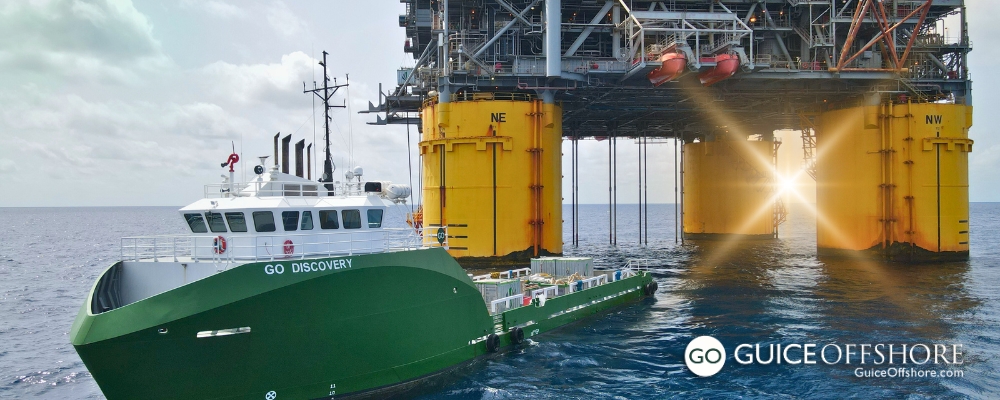
Guice Offshore earned a grade of A+ from the National Oceanic and Atmospheric Administration’s (NOAA’s) National Ocean Service for exercising diligence and commitment in adhering to safe speed limits designed to protect the North Atlantic right whales while transiting protected waters of the Stellwagen Bank National Marine Sanctuary during the first half of 2025. Our mini supply vessel GO Liberty received a separate certificate of corporate responsibility and a grade of A+ as well.
Portions of the Stellwagen Bank National Marine Sanctuary overlap the Cape Cod Bay and/or Off Race Point Seasonal Management Areas (SMAs) that were promulgated under NOAA’s 2008 Final Rule to Implement Speed Restrictions to Reduce the Threat of Ship Collisions With North Atlantic Right Whales. Created in 2008, the speed limits are designed to reduce the likelihood of deaths and serious injuries to these critically endangered whales that result from collisions with ships.
Mandatory speed restrictions of 10 knots or less are required in the Cape Cod SMA (Jan l-May 15, annually) and the Off Race Point SMA (Mar l-Apr 30, annually). Mariners are advised to refer to Coast Pilot 1 for information on these restrictions and to obtain additional information for reducing ship strikes.
As a courtesy to all operators transiting the Sanctuary that are also required to abide by the Right Whale Ship Strike Reduction Rule, Stellwagen Bank National Marine Sanctuary, in conjunction with the International Fund for Animal Welfare (IFAW) and the Greater Atlantic Regional Fisheries Office, monitors and grades all vessels that transited the sanctuary within either of the above identified SMAs as part of the Right Whale Corporate Responsibility Program.
In 2016, Stellwagen Bank National Marine Sanctuary and the International Fund for Animal Welfare initiated the Right Whale Corporate Responsibility Program, which involves encouraging companies to increase their commitment to behaviors that are in the public interest, such as Right Whale conservation, and recognizing deserving companies for their efforts.
The program uses Report Card data to categorize a company’s and ship’s level of commitrnent in the Off Race Point and Cape Cod Bay North Atlantic Right Whale seasonal management speed-restriction areas and grades them from A+ to F. Deserving companies and ships (A+ and A rated) receive a signed Certificate of Right Whale Corporate Responsibility, which is suitable for framing and display.
The Right Whale Corporate Responsibility Program is an ongoing initiative with the ultimate goal of providing top grades and certificates to all vessels and companies that transit these waters and showcasing deserving companies that demonstrate a commitment to Right Whale conservation and protection.
Free Smart Phone “Whale Alert” App Helps Mariners Avoid Right Whales and Monetary Fines
Collision between whales and ships is a problem that has drawn world-wide attention. From the United States to the Mediterranean to New Zealand, mariners are increasingly being asked to take action to reduce the risk of such collisions, but many receive little help in doing so.
Led by NOAA’s Stellwagen Bank National Marine Sanctuary, a consortium of scientists, industry representatives and conservation groups have developed the free “Whale Alert” app as part of the solution. Whale Alert is a free mobile application that provides the maritime community and others with up-to-date information pertaining to North Atlantic Right Whale management initiatives and regulations, and displays them on nautical charts. NOAA is the United States agency with responsibility for protecting endangered marine species, such as the North Atlantic Right Whale.
How Can Whale Alert Benefit Mariners?
In U.S. waters, mariners are required to abide by regulatory management initiatives designed to protect the highly endangered North Atlantic Right Whale (U.S. Law 50CF 224.105). Failure to comply with these regulations can result in substantial fines. To date, NOAA has issued penalty assessments ranging from $1 1,500 to $92,000 to ships violating speed restrictions in designated SMAs.
However, it is often difficult for mariners to stay updated on management measures and to know when they are in a special management zone. Whale Alert provides all mariner-relevant right whale information on digital nautical charts and displays them on an iPhone, iPad or Android device.
Using these devices to display Whale Alert has the advantage of keeping information separate from a ship’s ECDIS screen, thereby not inferring with navigation and safety. The charts can be automatically updated to ensure that mariners are receiving the most recent information possible. Whale Alert provides mariners with “one-stop shopping” for all the information they need to comply with measures designed to protect right whales.
- DOWNLOAD WHALE ALERT FOR FREE AT WHALEALERT.ORG.
What will Mariners See on Whale Alert?
Whate Alert provides mariners with a visual display of all relevant Right Whale management initiatives on digital nautical charts via their smart phone, including:
Current ship location – An icon depicts a ship’s real-time GPS derived location;
Seasonal Management Areas (SMA) – SMAs are ocean areas in which the US Government requires mariners to transit at speeds <10 knots. SMAs are active only during specific times of the year when Right Whales are historically present. SMAs appear on Whale Alert charts as orange-colored areas and are only displayed during the time period in which the SMA is active. As a ship enters an SMA a pop-up window (triggered by their GPS location) appears notifying the mariner that he/she should be traveling at a speed of less than 10 knots;
Mandatory Ship Reporting (MSR) – MSRs are areas that, when entering, a ship must contact the US Coast Guard to receive right whale information. MSRs are displayed in Whale Alert as a blue line that borders the reporting area. When a ship enters an MSR, a pop-up display appears reminding the mariner to report to the U.S. Coast Guard and providing information on reporting procedures;
Areas to be Avoided (ATBA) – International Maritime Organization-sanctioned ATBAs to protect Right Whales appear on the Whale Alert charts in red when and where they are active;
Recommended Routes (RR) – NOAA has established RRs in key Right Whale habitats that guide ships through areas with a reduced likelihood of collisions with whales. RRs are displayed in purple;
Dynamic Management Areas (DMAs) – DMAs are ocean areas where an aggregation of Right Whales has been sighted outside of an SMA. DMAs typically last 2-weeks and mariners are requested to reduce speeds to less than 10 knots when transiting. Active DMAs zones are shaded grey on the Whale Alert display;
Near real-time acoustic alerts – Right Whale acoustic detection buoys use moored hydrophones and satellite communications to quickly identify the presence of Right Whales in the Traffic Separation Schemes through and around NOAA’s Stellwagen Bank National Marine Senctuary. Detection buoys appear on Whale Alert charts as green circles. The circles turn yellow to indicate that a right whale has been detected within the past 24 hrs and a less than 10 knot speed is requested.
Sightings of whales can be submitted directly to the app’s Whale Alert database with the help of the whale ID guide contained in the app.
Whale Alert was designed with considerable input from the maritime community. The Massachusetts port Authority and Boston Harbor Pilots Association were lead groups, while NYK Line and the Norwegian and Holland America cruise lines were part.of a test fleet to gain additional industry input and make the Whale Alert app operational.
The U.S. Coast Guard was instrumental in working with this team to transmit information via the Coast Guard’s AIS system.
On the conservation side, the International Fund for Animal Welfare provided program input and funding. In addition to the Stellwagen Bank National Marine Sanctuary, scientists and engineers from the Bioacoustic Research Program at Cornell University, the Center for Coastal and Ocean Mapping at the University of New Hampshire, NOAA’s Northeast Fisheries Science Center, and the Woods Hole Oceanographic Institution provided expertise supporting different aspects of the app.
ConserveIO, with extensive experience in spatial mapping and real-time mobile data acquisition, developed the app itself.
To obtain the free Whale Alert mobile app go to whalealert.org.