On March 9, 2026, the U.S. Bureau of Ocean Energy Management (BOEM) released the 2026 National Assessment of Undiscovered Oil and Gas Resources, which is an estimate of the undiscovered, technically and economically recoverable oil and natural gas resources outside of known oil and gas fields on the U.S. Outer Continental Shelf (OCS).
- Click HERE to access the new (and previously published) National Assessment.
- Click HERE for related resources, including a fact sheet and other data.
The National Assessment, published every five years, represents BOEM’s current understanding of the distribution of undiscovered oil and gas resources on the OCS, and identifies opportunities for additional oil and gas exploration and development on the OCS.
Using a “play-based” assessment methodology, the National Assessment estimates a mean Undiscovered Technically Recoverable Resource of 65.80 billion barrels of oil and 218.43 trillion cubic feet of natural gas in the Outer Continental Shelf.
A “play-based” assessment is a geological and economic methodology used to estimate the volume of undiscovered, technically, and economically recoverable oil and natural gas resources on the OCS. Instead of focusing on a single, specific prospect, this approach analyzes a “play”—a group of potential oil and gas accumulations that share similar geologic, geographic, and temporal properties (such as source rock, migration path, and reservoir type).
Based on current production trends, these undiscovered resources represent the potential for 100 or more years of energy production from the shelf, supporting lower energy costs and job creation.
“The Outer Continental Shelf holds tremendous resource potential,” said BOEM Acting Director Matt Giacona. “This report provides the foundation for decisions that will ensure affordable energy and robust energy security for generations of Americans.”
The findings are derived from analyzing each geologic play across the Outer Continental Shelf and assigning a probability for the existence of undiscovered oil and gas resources for individual plays. Play results are then aggregated up to regional results and ultimately, a total Outer Continental Shelf estimate. Any changes from previous assessments reflect additional data and information acquired up to the data cutoff of Jan. 1, 2024.
The 2026 National Assessment represents a comprehensive appraisal through rigorous analysis of the best scientific data and information available and builds upon previous Outer Continental Shelf resource assessments. It is a critical tool for shaping the nation’s energy future—providing the data and insights needed to guide responsible development and ensure that America remains a global energy leader.
Guice Offshore Vessels — Part of the Offshore Oil and Gas Industry Toolbox
Guice Offshore’s mini supply vessel fleet is a trusted partner in offshore oil and gas operations. Our support vessels play a necessary and critical role in the offshore exploration and production (E&P) environment and are utilized in almost every phase of the extraction process from survey and drilling, to production and abandonment.
Guice Offshore (GO) maintains a strong presence in the northern Gulf of America E&P sector. our vessels are most often employed in support of Platform and Pipeline Operations (production activities, logistics, diving, ROV, inspection, maintenance, repair, plug and abandonment). We also participate in certain early phases of operations like surveying.
Geotechnical and Geologic Ocean Seabed Surveys
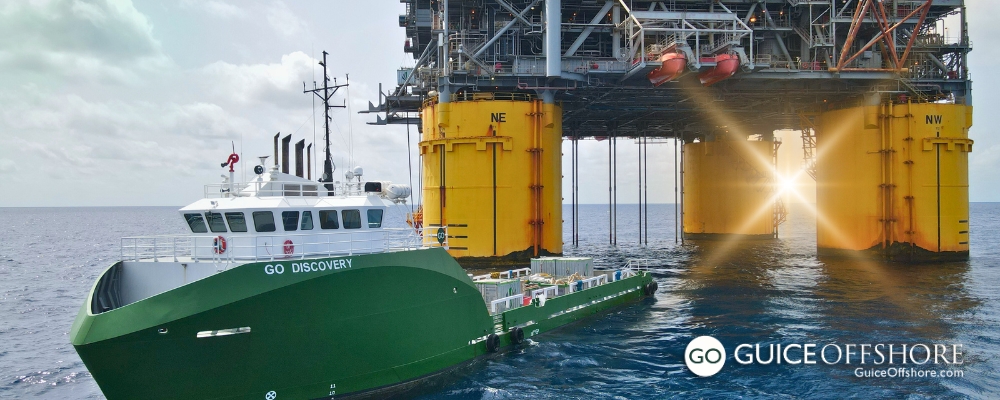
Utilizing vessels like Guice Offshore’s 150 ft. DP1 GO Liberty or the 170 ft DP1 GO Discovery, geotechnical companies can perform detailed survey activities for their oil and gas industry clients, such as seabed mapping, soil investigations and core sampling.
Depending on their equipment installed, Guice Offshore vessels can work in a variety of coastal or offshore environments and water depths. Open cargo decks, ample accommodations, excellent maneuverability and station-keeping, all coupled with an efficient cost of operations, makes the GO fleet a consistently reliable choice for the offshore oil and gas industry.
Oil Rig Inspection, Maintenance and Repair (IMR)
GO vessels facilitate the inspection, maintenance and/or repair of offshore pipelines, subsea structures, floating and fixed platforms and drilling rigs in a range of water depths. Our IMR support activities extend well beyond traditional oil and gas roles, and can include any number of industries such as offshore wind turbines, power cables, subsea or surface commissioning of structures, and sustainable energy equipment.
Often, IMR activities are conducted with Remotely Operated Vehicles (“ROVs”). Our GO Fleet possesses the accommodations, dynamic positioning (DP) station-keeping technology and removable side cargo rails necessary to support these operations.