



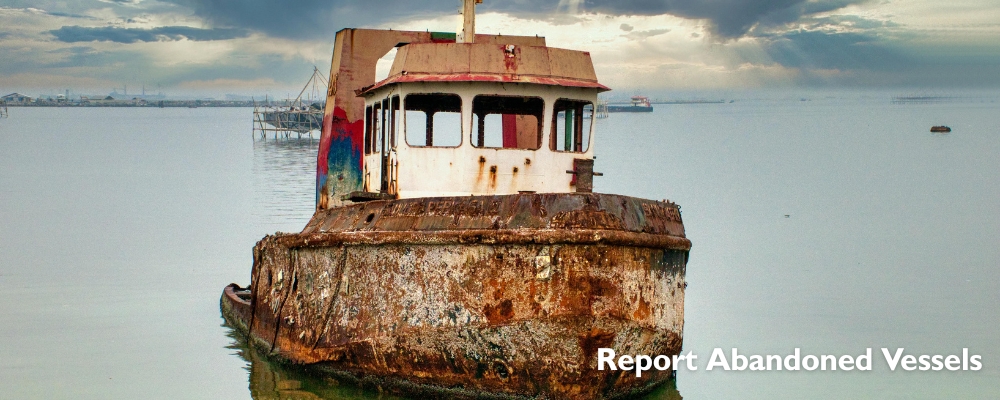
Database to support ongoing nationwide effort to remove and prevent ADVs
- To report an abandoned vessel, click HERE.
The non-profit BoatUS Foundation for Boating Safety and Clean Water has developed a database that will identify the locations of abandoned and derelict vessels (ADVs) across the U.S., as well as in freely associated states and U.S. territories, and then track their removal.
Created in partnership with the National Oceanic and Atmospheric Administration (NOAA) Marine Debris Program, this national database will allow visitors to report abandoned and derelict vessels on their coastlines, allowing the issue to be better understood on a national scale with the support of the public. Eventually, this database will be able to track the impacts of removal and prevention efforts by showing how the number of ADVs across the country may one day decrease.
Abandoned and derelict vessels can crush or smother sensitive plants and corals, leach fuel and other pollutants into the water, threaten safe navigation, and contribute to economic losses. Removing ADVs is a costly effort, often averaging more than $24,000 to remove a single boat.
“When we finally understand the scope of the problem, communities all over the country will be better able to remove abandoned and derelict vessels on their local coastlines,” said BoatUS Foundation Director of Outreach Alanna Keating. “With the information the database provides, they will be able to know exactly where they need to dedicate resources, whether that be towards removing vessels or preventing them from becoming abandoned in the first place. This database is just one part of our critical work that could help make ADVs a thing of the past.”
Along with the database, the BoatUS Foundation awarded grants this year to support ADV removal efforts across Alaska, Guam, Louisiana, Maine, North Carolina, Oregon, the U.S. Virgin Islands and Washington.
The database, regional removal grants, and efforts to raise awareness on boating-related debris disposal—including the Second annual “Turning the Tide” conference in New Orleans in December 2026—are supported by the NOAA Marine Debris Program.
Turning the Tide Summit New Orleans 2026
The BoatUS Foundation, with support from the NOAA Marine Debris Program, is excited to announce 2026 Turning the Tide Summit in New Orleans.
The Turning the Tide Summit is open to environmental experts, boating enthusiasts, environmental agency staff, policymakers and industry leaders. Attendees will have access to resources, panel discussions and keynote addresses that focus on ADVs and sustainable disposal solutions for boating related waste, including fiberglass and shrink-wrap.
Are you interested in speaking? Do you want to share your vision, expertise, and insights on ADVs, sustainable disposal solutions for boating-related waste? If so, please submit your presentation for consideration HERE.
The Summit will be December 6-9, 2026, at the Sheraton, New Orleans.
BoatUS Foundation is leading a nationally competitive grant program for the removal of abandoned and derelict vessels throughout coastal and marine areas of the United States, including the Great Lakes, U.S. territories, and Freely Associated States. This project is supported by the NOAA Marine Debris Program. In an effort to help educate and prevent future ADVs, the Foundation will also create a national ADV database to track the scope of the challenge and measure success, document ADV prevention and removal activities to share with the public, and support a national dialogue and education efforts on boating-related debris disposal. Learn more about the Marine Debris Program by visiting marinedebris.noaa.gov.
A Shared Mission for a Cleaner Gulf Coast
Abandoned and derelict vessels are more than just unsightly. They leach pollutants into marine ecosystems, endanger boaters, and block vital waterways. Communities throughout the Gulf Coast are coming together to clean up their local waters.
With support from the National Oceanic and Atmospheric Administration (NOAA) Marine Debris Program, the Gulf of America Alliance (“the Alliance”) is working in coordination with state and local partners on a large-scale, multi-state initiative to remove derelict vessels and restore coastal health and safety. Over the course of four years, vessels are being removed across the Gulf Coast, with recent removals taking place in Texas, Mississippi, and Alabama.
Texas: Safeguarding Coastal Life in Galveston County
In Texas, five derelict fiberglass vessels sunk deep in the Gulf-bottom mud were removed from south Galveston County, including high-traffic areas of Offatts Bayou and the Gulf Intracoastal Waterway.
The boats, located near homes, restaurants, and a major bridge, were hazardous to marine life and the public, and created eyesores in popular coastal areas important to local tourism.
“I am thrilled that through our partnership with the Gulf of America Alliance, five abandoned boats in Offatts Bayou and the Gulf Intracoastal Waterway were safely removed, eliminating their threat to the area’s vital marine ecosystem and fishing community.”
– Dawn Buckingham, M.D., Texas General Land Office Commissioner
Led by the Alliance in coordination with the Texas General Land Office and Mississippi State University’s Coastal and Marine Extension Program, the removed vessels amount to more than 21,000 pounds of debris. “As a former resident of Galveston Island for over a decade, preserving the health and beauty of its coastal waters is a mission close to my heart,” Buckingham added. “The safe removal of abandoned vessels is essential to the General Land Office’s efforts to protect marine life and coastal communities from the considerable risks presented by these unsightly hazards, including leakage of fuels and toxic chemicals.”
Mississippi: A Community-Led Cleanup Effort
In Mississippi, the Alliance partnered closely with the Mississippi Department of Marine Resources and its Derelict Vessel Program to remove nine vessels each from Hancock and Harrison counties, totaling 18 since the summer of 2024.
These vessels, varying in type and material—from steel and fiberglass fishing boats to wooden houseboats—accounted for more than 411,000 pounds of debris removed from coastal waters.
The success of this effort is deeply tied to the community. The Department’s program depends on local volunteers who identify derelict vessels and take pride in protecting their waterways and coastal parks.
“When they (local citizens) are included in the vessel removal process, they feel ownership, pride, and will become better stewards of their local waterways, parks, and wilderness areas.”
– Roy Lipscomb, Mississippi Department of Marine Resources’ Derelict Vessel Program Coordinator
Lipscomb also emphasized the ecological and navigational dangers posed by derelict vessels. “The biggest benefit of the removal of an abandoned and derelict vessel in a small waterway is that the tidal flow is not impeded anymore. I have seen vessels blocking most of a canal or bayou. Then debris, logs, and aquatic plants start to clog the waterway and basically stop the natural water movement.”
In addition to restoring water flow and improving the health of nearshore habitats, removing submerged vessels prevents serious boating accidents. Navigating in limited visibility is dangerous, and GPS often won’t detect underwater hazards.
Alabama: Restoring Flow to Coastal Waters
In Alabama, the Alliance collaborated with the Alabama Law Enforcement Agency, Mississippi State University’s Coastal and Marine Extension Program, and MD Thomas Construction, LLC to remove 10 derelict vessels in Baldwin County and the Perdido River/Bay area during March and April 2025.
These vessels totaled an estimated 150,000 pounds of debris removed, and included sailboats, cabin cruisers, houseboats, and two barges.
“It’s important to remove ADVs [abandoned and derelict vessels] because of the danger they pose to boaters navigating in unknown waters or during limited visibility. Also, ADV removal restores natural water flow and supports healthier ecosystems.”
– Laura Bowie, Executive Director, Gulf of America Alliance
The project was a team effort. MD Thomas Construction handled the removal and disposal of the vessels, Alabama Law Enforcement ensured regulatory compliance, and Mississippi State University Coastal Marine Extension managed on-site coordination between all parties.
Collective Action, Lasting Outcomes
Across Texas, Mississippi, and Alabama, the removal of derelict vessels reflects a coordinated effort to improve public safety and navigation, restore natural waterways, and reduce environmental toxins and hazards. With continued support from the NOAA Marine Debris Program, the Gulf of America Alliance and its partners are creating cleaner and healthier coastal communities.
To learn more about this project, visit the NOAA Marine Debris Program website.