



Seagate Space’s Modular Offshore Launch Platform is the First Offshore Asset to Meet New ABS Spaceport Requirements
ABS has granted approval in principle (AIP) to Seagate Space for their unmanned semi-submersible launch platform – the first offshore asset to receive an AIP under the new ABS Requirements for Offshore Spaceports.

“Safety and precision are critical to the success of offshore space launch operations. This AIP reflects both ABS’ and Seagate Space’s commitment to advancing innovative technologies that enable reliable and efficient launch operations in a fast-evolving sector. ABS is proud to continue shaping the offshore infrastructure critical to supporting space launches across the globe,” said Miguel Hernandez, ABS Senior Vice President, Global Offshore.
The platform, designed specifically for remote offshore launch operations and referred to as the Gateway-S, introduces a new category of modular offshore spaceport infrastructure. Gateway-S can be configured for both launch and recovery as well as disassembled into container-sized modules for transportation by sea, truck or rail, allowing for multi-site deployments.
Other key features of the design include its semi-submersible hull form, which reduces wave-induced motion, and deck arrangement which can facilitate various mission- specific equipment.
“Our customers in the space industry are truly transforming humanity’s future, and we are proud to be at the forefront of supporting their unique maritime needs. Gateway-S is the first of a series of configurations that achieve greater capability at a more efficient cost point,” said Sean Fortener, Co-Founder and COO/President of Seagate Space.
Offshore recovery missions have skyrocketed over the past decade, soaring from just two in 2015 to over a hundred in 2024. Specialized barges and offshore support vessels enable this rapid growth, serving as a key theatre for an array of offshore operations in support of the expanding commercial space industry.
Offshore spaceports enable more convenient and efficient launch operations by moving operations to sea, reducing public impact while relieving pressure on shore-based spaceport infrastructure.
The platform was approved in principle with applicable standards in ABS Requirements for Offshore Spaceports and ABS Rules for Building and Classing Offshore Units (Offshore Rules). An intermediate approval step, AIPs assist in demonstrating project feasibility of novel concepts to project partners and regulatory bodies.
ABS has taken a leading role in the development of industry requirements for offshore space infrastructure. It published the world’s first requirements addressing the unique challenges of offshore spaceports in 2023 as well as a joint development project reviewing remotely controlled dynamic positioning functions of autonomous rocket recovery droneships with SpaceX.
Learn more about ABS’ industry-leading work supporting the space industry here.
First-Ever International Requirements for Offshore Spaceports Developed by ABS in 2023
Recognizing the increase in global demand for offshore spacecraft launch and recovery, ABS announced the publication of the first international requirements for the design and construction of offshore spaceports during the 2023 Offshore Technology Conference (OTC) in Houston.
ABS produced a new set of requirements based on service experience with industry leading aerospace rocket launch and recovery companies to guide the burgeoning maritime aspects of the space flight industry in the safe design and construction of offshore assets. Previously there were no industry requirements to address an offshore spaceport’s unique concept of operation.
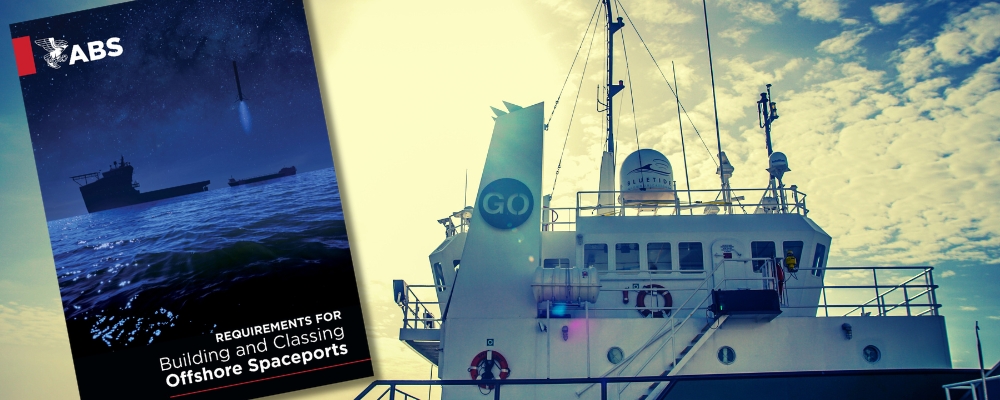
Spaceports are marine or offshore assets that conduct spacecraft launch or recovery. The ABS Requirements for Building and Classing Offshore Spaceports addresses several vessel types including barge type units, column-stabilized, offshore installations and self-elevating units.
“The offshore space industry is growing rapidly, and ABS is already a pioneer in the field of offshore space support with our industry-leading work on autonomous rocket recovery droneships. This new publication allows ABS to provide clear support for organizations that are engaging with regulatory agencies to reactivate assets such as offshore support vessels, barges and liftboats to support space flight,” said Miguel Hernandez, ABS Senior Vice President, Global Offshore.
ABS is at the forefront of offshore space support. Learn more here about ABS’ joint development project with SpaceX to review the remotely controlled functions of autonomous rocket recovery droneships used for booster rocket recovery at sea.
Download a copy of the ABS Requirements for Building and Classing Offshore Spaceports here.
With more than 70 years of experience in the offshore sector, including decades with specialized offshore support vessels, ABS is committed to providing expert guidance and solutions for safely managing assets in offshore operations. Read more here.
What is an Offshore Spaceport?
ABS defines an offshore spaceport as a marine or offshore unit designed for the launch, recovery, or testing of high altitude and space crafts. These spaceports come in various forms, each tailored to specific operational needs:
- Launch Vessels: Offshore vessels, often OSVs, specifically designed for launch operations.
- Barge-Type Units: Floating platforms commonly used for rocket landings.
- Column-Stabilized Units: Semi-submersible platforms providing stability in open, shallow waters.
- Self-Elevating Units (Jackups): Platforms that elevate above the water for enhanced launch stability.
- Offshore Installations: Fixed or moored offshore structures for long-term operations.