




Watch live this week as explorers on Ocean Exploration Trust’s Exploration Vessel Nautilus conclude a 21-day expedition led by Dr. Robert Ballard in search of Iron Bottom Sound, the site of five major naval battles during the early years of the Allied Pacific campaign during World War II.
The 1942 Solomon Islands Campaign was the Allies’ first large-scale offensive initiative of World War II to halt and reverse Imperial Japanese expansion in the Pacific, breaking the pattern of Japanese territorial gains. While broadly known for brutal jungle warfare following the amphibious landing on the island of Guadalcanal, a series of fierce night-time naval engagements in the surrounding waters resulted in heavy losses on both sides. Over 100 naval vessels were lost during battles here, but only 30 have been located, and at least 21 remain to be found in the deep waters of Iron Bottom Sound.
Scheduled to conclude on July 23, 2025, this 21-day expedition will utilize the remotely operated vehicle and telepresence systems of E/V Nautilus, in combination with the mapping capabilities of uncrewed surface vehicle DriX, to conduct non-invasive archaeological surveys of cultural heritage sites in the Iron Bottom Sound.
Located in the Solomon Islands between the islands of Guadalcanal, Savo, and Nggela, Iron Bottom Sound was the stage of five major naval battles between August and December 1942 that resulted in the loss of over 20,000 lives, 111 naval vessels, and 1,450 planes.
These underwater cultural heritage sites now rest on the seafloor offshore Honiara in a confined area less than 25 nautical miles wide, 40 nautical miles long, and 1,400 meters deep. To date, fewer than 100 of these US, Japanese, Australian, and New Zealand military ships and planes have been located.
The Iron Bottom Sound expedition is one of five this year that Ocean Exploration Trust (OET) and its partners will undertake in deep-sea habitats in the Western Pacific using E/V Nautilus, its mapping sonars, ROV systems, and other exploration technologies brought aboard from the NOAA Ocean Exploration Cooperative Institute (OECI).
This expedition is funded by NOAA Ocean Exploration via the Ocean Exploration Cooperative Institute.
During the expedition, the team will use the University of New Hampshire’s uncrewed surface vehicle DriX , controlled from a shore-based station in Honiara, to create high-resolution maps of shipwrecks in Iron Bottom Sound. They will then deploy E/V Nautilus’ remotely operated vehicles to conduct non-invasive video surveys, focusing on wrecks which have not yet been imaged at a high resolution. The coordinated technology approach being used during this expedition demonstrates new efficiencies in maritime archaeology and ocean exploration.
The Maritime Archaeology of Guadalcanal expedition is supported by NOAA Ocean Exploration via the Ocean Exploration Cooperative Institute. This exploration is made possible by the expertise, support, and collaboration of many partners, including NOAA Ocean Exploration, U.S. Naval History and Heritage Command, Solomon Islands government, University of New Hampshire Center for Coastal and Ocean Mapping/Joint Hydrographic Center, and Japanese, Australian, and New Zealand colleagues.
The 2025 E/V Nautilus expeditions are primarily sponsored by NOAA Ocean Exploration via the Ocean Exploration Cooperative Institute, including additional support from the Bureau of Ocean Energy Management in collaboration with the US Geological Survey.
Read about the upcoming expeditions below. To read about all the previous expeditions, click HERE.

About the Ocean Exploration Trust Expeditions
The five 2025 expeditions will build ocean knowledge supporting international scientific and U.S. governmental priorities, particularly understanding ocean changes, sharing that knowledge with others, and contributing new discoveries and data to inform future conservation and resource management decisions. The goals of these expeditions are co-developed with national exploration priorities and input from scientists, resource managers, and local community stakeholders in the regions where the expeditions will take place.
“With the vast majority of our ocean remaining completely unexplored, we need to be strategic in terms of where to focus our exploration efforts to have the biggest impact in terms of making new discoveries, as well as advancing science and resource management priorities,” said Daniel Wagner, OET Chief Scientist. “Over the last year, we have been working with numerous scientists, resource managers, educators, and other stakeholders to co-develop expedition plans that address priority needs.”
Through the open sharing of data collected during these expeditions, we will build upon decades of study, stewardship, and discoveries. Mapping and ROV operations will directly contribute to the US National Strategy for Ocean Mapping, Exploration, and Characterization, the Beyond the Blue: Illuminating the Pacific campaign, and other coordinated initiatives. The integration of different technologies, including landers and autonomous underwater vehicles, into operations on E/V Nautilus continues to advance national priorities for increasing the efficiency and sophistication of multi-vehicle ocean exploration.
“NOAA Ocean Exploration is looking forward to another season of exploration in the Pacific Ocean with our partners at OECI and OET,” says Dr. Aurora Elmore, NOAA Ocean Exploration Cooperative Institute Program Manager. “With the new and emerging technologies that will be used this year, we are excited to fill gaps in basic understanding of the deep-ocean environment, from learning more about previously unseen geological features and creatures to advancing the science that underpins resource management.”
From May to September 2025, E/V Nautilus expeditions will be streamed live on NautilusLive.org, a 24-hour platform that brings ocean exploration directly to viewers on shore. Telepresence technology allows viewers to engage with the team at sea, asking questions and receiving real-time behind-the-scenes updates via social media. Classrooms worldwide are invited to connect with the at-sea team of STEAM professionals via free educational Q&A interactions. Additionally, OET offers free STEAM educational resources for K-12 learners in English, Spanish, Palauan, Samoan, and ʻŌlelo Hawaiʻi, including national-standard aligned activities, engineering design challenges, and creative projects for learners in the classroom or at home.
Ocean Exploration Trust is committed to building connections with local communities in expedition regions through co-developing expedition plans, making data publicly accessible, and coordinating outreach with schools and community groups. As E/V Nautilusis a guest in the Western Pacific, we honor and acknowledge the many cultures that have a deep connection to this ocean region and continue to steward through generations the ocean, seas, coastlines, and lands.
Upcoming Ocean Exploration Trust Expeditions
The Republic of the Marshall Islands is an atoll-based country of over 1,200 islands surrounded by 2.13 million square kilometers of ocean, the vast majority of which has never been mapped or surveyed. Despite data gaps, it’s known that the deep sea of Aolepān Aorōkin Ṃajeḷ hosts rich and diverse marine resources, including over 300 unexplored seamounts, extensive deep-sea ridges and escarpments, and numerous historically significant underwater cultural heritage sites associated with World War II. This 21-day telepresence-enabled expedition will utilize the mapping, ROV, and telepresence systems of E/V Nautilus to collect critical ocean baseline information to support the Marshall Islands Marine Spatial Planning process, as well as long-standing collaborations between the U.S. and the Marshall Islands on protecting fisheries and the environment and strengthening regional security.
This expedition is funded by NOAA Ocean Exploration via the Ocean Exploration Cooperative Institute.
During this expedition, E/V Nautilus explores the waters offshore Howland & Baker Islands. Located roughly midway between Hawaiʻi and New Zealand in the Central Pacific Ocean, the islands of Howland and Baker are some of the most isolated land masses on Earth. While there have been some scientific expeditions to this remote region, the vast majority of the 425,700 square kilometers of seafloor surrounding Howland and Baker remain unmapped, and represent one of the most poorly surveyed areas under US jurisdiction. This 22-day expedition will use the deep-water mapping capabilities of E/V Nautilus to map previously unsurveyed seafloor in the US Exclusive Economic Zone around Howland and Baker, as well as other unmapped areas along the transit route between the Marshall Islands and the Cook Islands. In addition to continuous seafloor mapping operations, the expedition will also include daytime seabird surveys from the observation deck on E/V Nautilus.
This expedition is funded by NOAA Ocean Exploration via the Ocean Exploration Cooperative Institute.
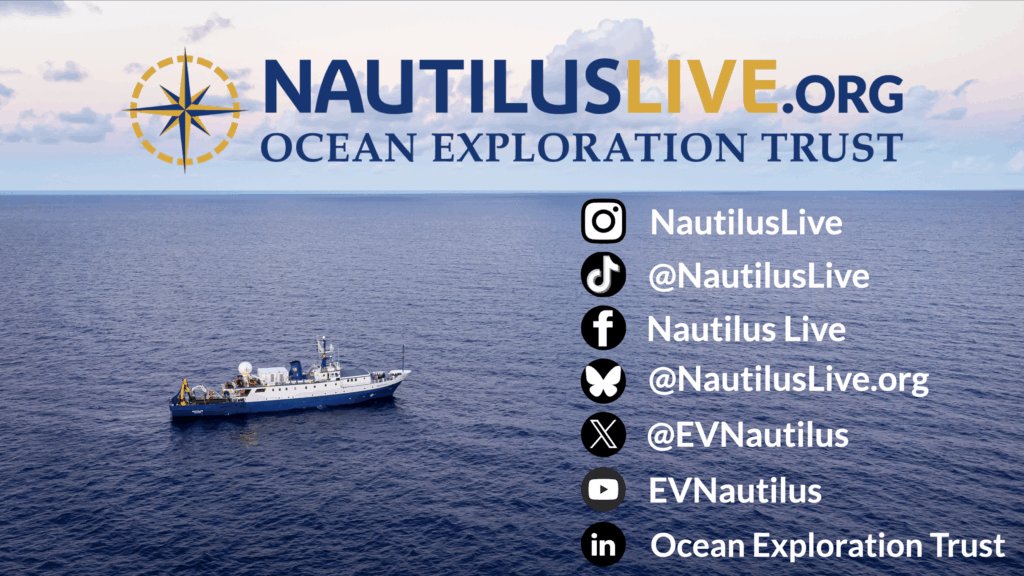
E/V Nautilus and Ocean Exploration Trust Fact Sheet
- The Ocean Exploration Trust was founded in 2007 by famed oceanographer and explorer Dr. Robert Ballard to explore the ocean, seeking out multi-disciplinary discoveries while pushing the boundaries of STEAM education and technological innovation.
- This international program centers on scientific exploration of the seafloor launched from aboard the Exploration Vessel Nautilus, a 68-meter (224-foot) research vessel currently based in the Western Pacific Ocean.
- In addition to conducting scientific exploration, the Nautilus Exploration Program offers telepresence to explorers on shore via live video, audio, and data feeds from our ship. Education is central to the mission, including at-sea professional training opportunities that bring educators and students on exploration expeditions.
- The 2025 E/V Nautilus expeditions are funded by NOAA Ocean Exploration via the Ocean Exploration Cooperative Institute, including additional support from the Bureau of Ocean Energy Management in collaboration with the US Geological Survey. OET program sponsors and partners also include the Office of Naval Research, QPS, the Phillip Stephenson Foundation, and private donors.
- Nearly three-quarters of our planet is covered by water, yet only 26% of the world’s ocean is mapped in high resolution. Over 99% of the ocean has never been visualized by humans. Exploring the ocean is critical for understanding our planet and informing management for a healthy ocean into the future.
- E/V Nautilus: The 224-foot (68-meter) ship is equipped with all of the latest in ocean technology and can host a 34-person science team, in addition to 17 crew members. The ship is outfitted for a two-tiered approach to exploration. First, the team uses a multibeam sonar system to map unknown areas of the seafloor. Once the data is analyzed and targets are chosen, they use remotely operated vehicles (ROVs) to collect video footage and a variety of samples. The ship also serves as a platform for testing and deploying other exploration technologies.
- ROV Hercules: This neutrally buoyant yellow remotely operated vehicle (ROV) is the workhorse of the Nautilus Exploration Program, and it is always used in tandem with Atalanta. Hercules is equipped with six thrusters that allow the pilots to “fly” it in any direction, plus two manipulator arms designed for collecting samples and recovering artifacts. Video from Hercules‘ high-definition cameras is streamed up a fiber-optic cable to the control van on Nautilus, then out to the world. It is capable of operating down to 4,000 meters.
- ROV Atalanta: This stainless steel towsled-style ROV is typically used in conjunction with Hercules, although it can be operated alone. When used in tandem, Atalanta absorbs the roll of the ship above so Hercules can remain steady through sensitive operations. It also provides additional light and serves as an “eye in the sky” during operations. When operating alone, it can dive deeper than Hercules, down to 6,000 meters.
- Expeditions stream live on NautilusLive.org, a 24-hour interactive platform that brings exploration directly to viewers on shore. Classrooms worldwide can connect with the at-sea team via free educational Q&A interactions and dive into a suite of educational material.
- Learn more at NautilusLive.org
